
Skopje, North Macedonia: A City of Fortresses, Bazaars, and Reinvention
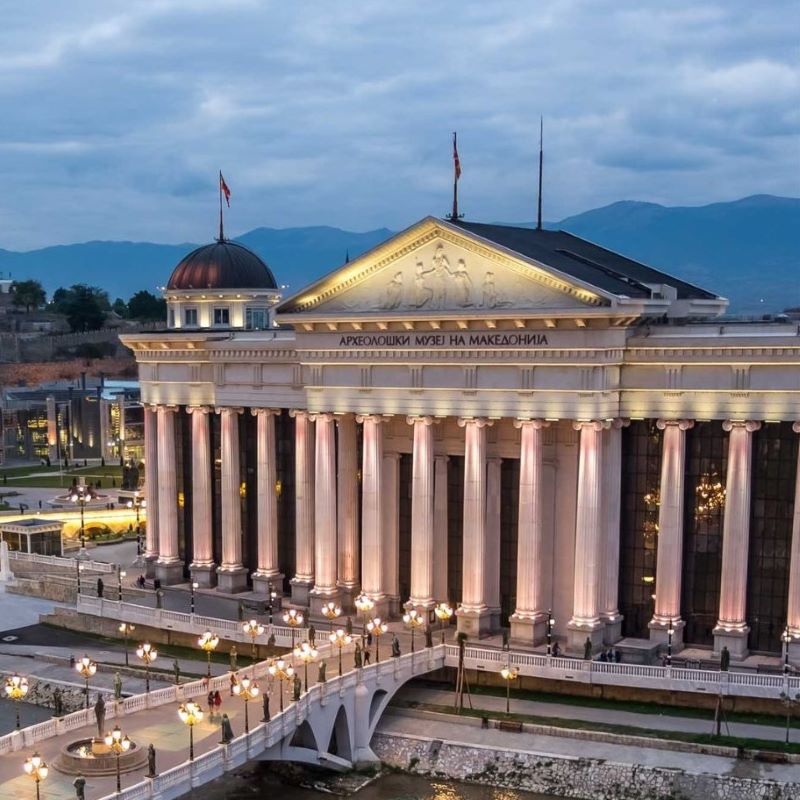
Skopje gives first-time visitors a lot to take in. The Vardar River cuts through the center. Bridges connect very different urban scenes. One side carries broad squares, statues, and government buildings. Another side opens into the Old Bazaar, where stone lanes, hammams, mosques, inns, and craft shops keep an older rhythm alive. That contrast gives Skopje its energy. You feel the city’s layers right away, and each walk reveals another chapter. As the capital and largest city of North Macedonia, Skopje anchors the country’s political, cultural, and economic life, yet it still feels close enough for a visitor to grasp in two or three days.
That strong first impression comes from history as much as scale. Skopje began as ancient Scupi, later grew under Roman rule, developed into a major Ottoman trading center, suffered a devastating earthquake in 1963, and then reshaped itself again in the 21st century through the highly visible Skopje 2014 makeover. Each period left something behind. Some traces sit in ruins, some in street plans, some in domes and stone bridges, and some in the polished facades around Macedonia Square. For travelers with limited knowledge of the Balkans, Skopje works well because the city explains regional history in a very visual way.
A Capital Built, Broken, and Reimagined
Skopje’s long story begins with Scupi, the ancient settlement that stood near today’s city. Britannica describes Skopje as a city that began as ancient Scupi and later became the capital of Dardania under the Roman emperor Diocletian. That early background matters because it shows that Skopje grew from a place of movement, administration, and exchange. The city has served as a crossroads for a very long time, and that role still shapes how it feels today. Roads, rivers, trade, and politics all converge here. When you explore Skopje, you move through a capital whose roots reach deep into classical and medieval history.
The Ottoman centuries added another major layer. The Old Bazaar, which national tourism sources date back to the 12th century and describe as a complex economic, architectural, and cultural unit, came into fuller development from the 15th to the 19th century. Inns, baths, mosques, workshops, and market lanes turned this part of Skopje into the city’s commercial heart. That legacy still shapes the visitor experience today. The bazaar carries real texture. Cobblestones, low shopfronts, tea, metalwork, grilled food, and voices from different communities all give the area depth and warmth. This part of Skopje tells you that trade built the city as surely as politics did.
Then came 1963. Britannica states that Skopje was largely destroyed by an earthquake that year, and the city’s own heritage material notes that Kale also suffered heavy damage. The rebuild that followed gave Skopje a strong modernist identity. Decades later, the Skopje 2014 project added another dramatic turn by introducing monuments, new facades, and a more classical visual language in the center. BIRN’s Skopje 2014 Uncovered database and later academic work both show how deeply this project entered public debate and memory. For travelers, that means the city center carries an argument in stone. Skopje invites you to look at architecture and ask what each period wanted the capital to say about itself.
The Vardar, the Basin, and the Mountains Around the City
Geography helps explain Skopje’s personality. The city stands on the banks of the Vardar River, and the official city portal describes it as spread along the river in the northern part of the country. Britannica places Skopje amid mountainous country, which fits the visual reality of the city very well. The basin creates a broad urban floor for boulevards, squares, and neighborhoods, while the surrounding heights give Skopje a strong horizon. You see that contrast from bridges, from higher viewpoints, and from the road into town. The city feels open at street level and enclosed by nature at the edges.
The mountains around Skopje add another layer to the experience. The city’s official facts page lists Skopska Crna Gora among the major surrounding ranges and includes Shar in the city coat of arms, while national geography references place the wider Vardar valley within mountain-framed terrain. This setting matters for visitors because it keeps nature close to urban life. A day in central Skopje can begin with fortress walls and end with canyon cliffs or mountain views. That easy shift from city streets to nearby landscapes gives the capital a more varied feel than its size might suggest.
The Sights That Explain Skopje Best
Kale Fortress offers the clearest place to start. It rises above the river and the bazaar, and national tourism material describes it as a major strategic point through history and one of the city’s symbols. The site also reaches far back in time, with evidence of settlement from prehistoric and early historic periods. For a visitor, Kale works on two levels. First, it gives a strong overview of the city’s layout, with the river, bazaar, bridges, and newer center all visible in one sweep. Second, it shows how Skopje’s history rests on command of space. The hill mattered in military, urban, and symbolic terms, and it still does.
From Kale, the route naturally drops into the Old Bazaar. This remains one of Skopje’s essential experiences because it gathers history, food, architecture, and local life into one walkable area. The tourism description highlights Kapan An, Suli An, Kurshumli An, Daut Pasha Hammam, Chifte Hammam, and a concentration of traditional crafts. That gives the bazaar much more than postcard value. It still feels functional. You can browse metalwork, sit for tea, stop for kebabs, admire old courtyards, and wander from shop to mosque to gallery in a short stretch. The area rewards curiosity and patience. Slow walking suits it best.
Cross the Stone Bridge and the city changes mood. Macedonia Square opens wide, framed by grand facades and monuments linked to the Skopje 2014 transformation. The best-known landmark here is the Warrior on a Horse statue, a centerpiece of the revamp and one of the city’s key visual markers. Even visitors who arrive with little background sense that this part of Skopje tells a different story from the bazaar. The square feels ceremonial, polished, and designed for spectacle. That contrast gives Skopje its tension and its appeal. You move from Ottoman trade streets to monumental capital imagery in minutes. Few Balkan capitals present their competing historical visions so openly.
A short walk away, the Mother Teresa Memorial House adds a more intimate note. The official memorial site describes the exhibit as following her life from childhood in her native Skopje through her years as a missionary of charity. That makes the site valuable even for visitors with only a general knowledge of Mother Teresa. It roots a global figure in a local setting and reminds you that Skopje has shaped lives that reached far beyond the Balkans. The stop also softens the city’s grand narratives. After fortresses, empires, and monuments, you enter a more personal story tied to memory, faith, and humanitarian work.
Everyday Skopje Lives in Food, Cafés, and Neighborhood Rhythm
Skopje becomes far richer once you move beyond landmark-hopping. The bazaar’s hammams and caravanserais show the city’s older social life, yet the present-day version lives through food and conversation. A street-food burek crawl makes perfect sense here because Skopje suits travelers who enjoy casual eating as part of exploration. Burek, yogurt, grilled meat, and strong coffee all fit the city’s pace. They also fit its mix of influences. Macedonian, Albanian, Turkish, and Roma traditions all contribute to Skopje’s sound, flavor, and daily street life, which gives the capital a layered identity that visitors can feel even before they fully understand it.
Later in the day, Debar Maalo offers a different urban mood. National tourism guidance suggests Debar Maalo for café culture, and local nightlife coverage regularly describes it as one of the city’s central evening districts. That reputation fits the area well. Streets here invite long dinners, drinks, and slow conversation rather than rushed sightseeing. This matters because Skopje reveals itself just as clearly at night as it does in daylight. A day in the capital works best when it includes both. Spend the afternoon with stone walls and museums, then let the evening unfold over coffee or wine in a neighborhood that shows the city at ease with itself.
A Capital of Different Communities and Strong Local Energy
Skopje’s cultural identity comes from coexistence and overlap. Census-based city data shows a clear mix of Macedonian, Albanian, Roma, Turkish, Serbian, Bosniak, and Aromanian communities, while broader national references underline the importance of Albanian, Turkish, and Roma Muslim traditions alongside Orthodox Christian life. Visitors do not need demographic tables to sense this. You notice it in language, food, places of worship, music, neighborhood character, and family names. That diversity gives Skopje vitality. The capital feels plural in a practical, everyday way. Its identity grows from contact and continuity rather than from one single story.
That same local energy appears in football culture. For visitors who want match-day atmosphere, FK Vardar offers one of the strongest sporting symbols in the city. Sources on the club and its supporters identify Komiti as Vardar’s loyal fan group and place them in the West Stand. A match adds another dimension to Skopje because it brings voice, color, and local pride into one shared space. Check the fixture list and seating plan before you go, then pick the experience that suits your comfort level. Even outside the stadium, football helps explain the city’s emotional life. It shows how strongly Skopje values belonging, rivalry, and collective ritual.
How to Plan a Strong Two or Three Days in Skopje
A 48-hour Skopje itinerary works very well. Give the first day to the center, Kale, the Old Bazaar, Macedonia Square, and the Mother Teresa Memorial House. That route introduces the city’s core themes in a compact area. On day two, head to Matka Canyon, which lies about 15 kilometers southwest of Skopje and covers around 5,000 hectares according to the canyon’s official site. The place combines dramatic cliffs, water, medieval remains, caves, monasteries, and outdoor activities in one easy day trip. Matka broadens your sense of Skopje because it shows how close the capital sits to deep natural scenery. City and canyon belong in the same trip.
A third day opens room for a more niche detour, and Kokino fits that role well. National tourism material places the megalithic observatory about 75 kilometers from Skopje and dates the site to the early Bronze Age, around 1800 BC. That makes it an appealing add-on for travelers who enjoy archaeology, landscape, and lesser-known heritage. Back in the city, practical movement stays simple through the bus network. Current JSP guidance tells riders to buy fares through the SkopjeBus app or use a reusable smart card available at JSP sales and service points. For timing, tourism guidance points to April through June and September through October as the most comfortable seasons for sightseeing, while July and August bring stronger heat.
Why Skopje Leaves Such a Distinct Impression
Skopje leaves a strong impression because it refuses a single mood. It can feel imperial, improvised, elegant, chaotic, reflective, and social within the span of one day. The city asks visitors to hold several histories at once. Roman foundations, Ottoman trade, socialist reconstruction, national symbolism, and everyday café life all share the same urban stage. That layered quality gives Skopje substance. You do not simply tick off sights here. You read a city that keeps revising itself while carrying its earlier selves in full view.
That is what makes Skopje, North Macedonia such a rewarding destination for a first trip and for a return visit later on. The capital offers enough famous landmarks for a classic city break, yet its real strength lies in how those landmarks connect to daily life. A fortress leads to a bazaar. A square leads to a memorial house. A bus ride leads to a canyon. A café leads to a long evening and a clearer sense of the place. Skopje gives visitors history, atmosphere, and movement in one compact setting, and that mix stays in memory long after the trip ends.

Tours that include this place
Skopje Matka Canyon
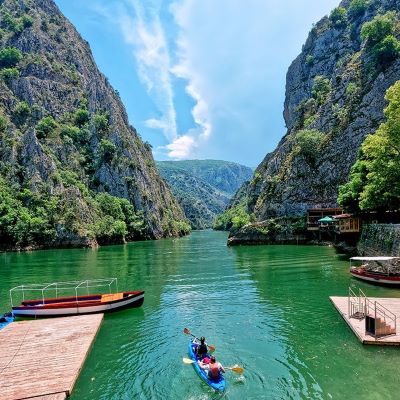
Explore Skopje’s Old Bazaar, Stone Bridge, and Kale, then boat Matka Canyon to Vrelo Cave. Cap the day with Bitola’s evening highlights. Capital contrasts and canyon calm in 13 hours.
Ohrid Skopje Matka

Lakeside Ohrid morning, Skopje’s Stone Bridge and Old Bazaar at midday, then boat Matka Canyon to Vrelo Cave. A seamless 12h sweep of culture, capital, and nature.
Skopje Pristina Journey

Start in Skopje’s Old Bazaar and Kale, then cross to Pristina for Mother Teresa Cathedral, NEWBORN, cafés and macchiatos. Capitals contrasted in one insightful day.