
Heraclea Lyncestis: Roman Ruins, Early Christian Mosaics, and the Ancient City
Heraclea Lyncestis sits on the southern edge of Bitola, close enough to fold into a city visit and rich enough to stand on its own. The site began in the middle of the 4th century BC under Philip II of Macedon and later grew into an important Roman urban center. In late antiquity, it also became a major early Christian episcopal center, which explains why the ruins bring together a Roman theatre, baths, basilicas, and some of the finest floor mosaics in North Macedonia.
What makes Heraclea so rewarding is the clarity of the place. Visitors do not need advanced knowledge of archaeology to understand what they are seeing here. The city plan still reads well. Public spaces still feel public. Sacred spaces still carry visual power. You can walk from civic remains to liturgical buildings in a short time, and each section helps explain the next. That is why Heraclea works so well for first-time visitors to Bitola and for travelers who want one site that connects Macedonian, Roman, and early Christian history in a very direct way.
Why Heraclea Matters in the Story of Bitola
Bitola has elegant streets, consular architecture, and strong café culture, yet Heraclea gives the city its much deeper historical foundation. The archaeological site lies just south of modern Bitola on the Pelagonia plain, which placed it in a strategic position from the start. Philip II founded the city as an important point in the region of Lynkestis, and later Roman development turned it into a thriving hub with strong regional importance. When travelers visit Bitola today, Heraclea helps them see that the area’s story began long before Ottoman mosques, 19th century facades, or modern city life.
That long arc of history is one of the site’s greatest strengths. Heraclea began as a Macedonian city, grew under Roman rule, and then took on a different identity as Christianity reshaped the urban world of late antiquity. Few places explain those shifts so clearly in one walk. Instead of reading about empire and religious change in the abstract, visitors can see how urban life itself changed over time, from theatre and baths to basilicas and episcopal buildings.
From Philip II to a Roman Provincial Center
The foundation story matters because it set the whole direction of the city. Official tourism and heritage sources place the founding of Heraclea in the middle of the 4th century BC and link it directly to Philip II of Macedon. He chose the site for strategic reasons, which made sense in a region where power depended on movement, roads, and control of key approaches. Later, Roman rule expanded the city’s scale and function, turning it into a true provincial center with the kinds of public buildings that marked urban life across the empire.
Heraclea’s position also tied it to wider communication networks. Scholarly material published by the Bitola museum links the city to the Via Egnatia, the great Roman route that connected the Adriatic world with the east. That connection helps explain why Heraclea flourished. Roads brought people, goods, ideas, and investment. Once that framework was in place, the city could support theatres, baths, formal residences, and the sort of civic life that gave Roman urban culture its shape.
A City That Became an Early Christian Episcopal Center
One of the defining features of Heraclea is the way the site carries its early Christian chapter. Sources describe it as an important episcopal center in the late Roman and early Byzantine periods, and the surviving remains make that status visible. The great and small basilicas, the bishop’s residence, and related structures show a city whose identity had shifted toward church life, liturgy, and ecclesiastical authority. This gives Heraclea a richer feel than a site built around Roman remains alone. It preserves the story of transition, not just the story of empire.
That transition also gives the site emotional range. A Roman theatre speaks of civic life, spectacle, and public gathering. A basilica speaks of worship, ritual, and a new spiritual order. At Heraclea, those two worlds stand within the same archaeological landscape. This makes the site especially useful for visitors who want to understand how the Balkans changed between antiquity and the early Christian centuries. You can feel that change in stone, in floor plans, and above all in the mosaics.
The Great Basilica and the Mosaics That Hold the Site Together
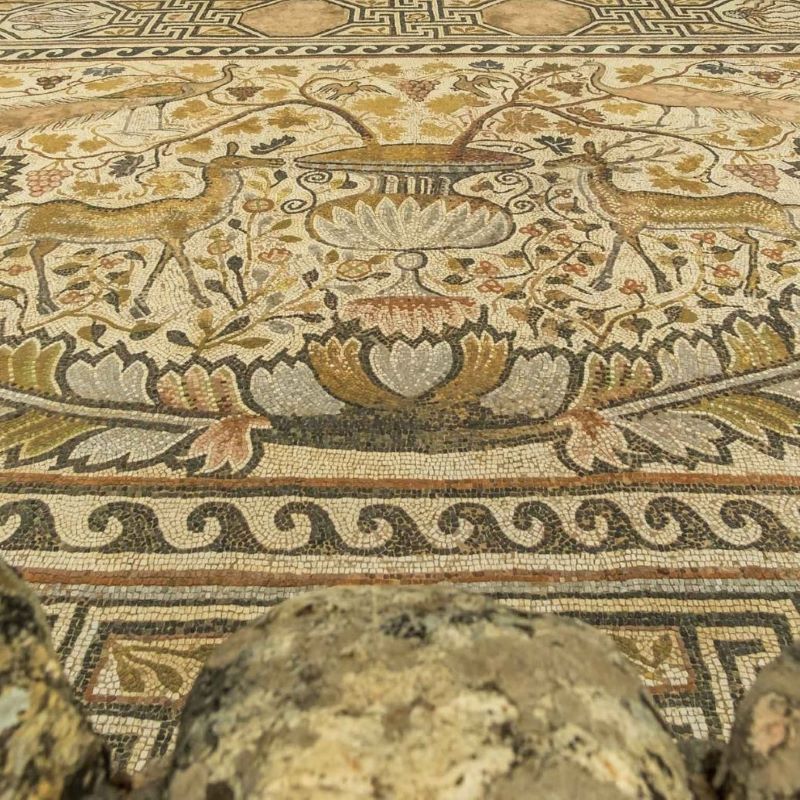
For many visitors, the visual heart of Heraclea lies in the Great Basilica. The site is famous for its early Christian floor mosaics, and the museum’s own material describes these as the finest and most significant mosaics uncovered there. The mosaic ensemble in the narthex and related areas carries rich figurative, floral, and symbolic imagery, and it gives the basilica an artistic gravity that turns a visit into something more than a survey of ruins. These floors still communicate beauty, hierarchy, and belief with remarkable force.
Part of the appeal comes from the way the mosaics still anchor the whole experience. Visitors move through open-air ruins, changing light, and fragmented walls, then suddenly encounter surfaces that feel highly ordered and visually complete. That contrast matters. It reminds you that Heraclea once held not just buildings, but fully composed interiors shaped by theology, wealth, and craftsmanship. If you enjoy photography, morning light often helps the patterns read more clearly and gives the mosaic fields a softer texture.
The Roman Theatre, Small Baths, and the Shape of Daily Life
Heraclea also preserves the public side of ancient urban life very well. The Roman theatre remains one of the site’s anchor monuments, and official museum material lists it among the major features of the complex. Tourism sources also highlight the theatre and Roman baths as essential parts of the visit. These are the remains that help a traveler imagine how the city functioned on an ordinary day. People came together here for performance, for civic gathering, and for the routines of urban life that defined the Roman world.
The baths deepen that sense of everyday reality. A bath complex makes the city feel inhabited in a very human way. It reminds visitors that Heraclea was not only a ceremonial or strategic place. It was a lived city with habits, schedules, and social rituals. The same applies to the smaller architectural remains across the site, including streets, drainage, and residential or administrative sections. Each fragment helps turn the ancient city from a remote historical name into a place that once worked hour by hour.
The Episcopal Residence and What It Tells You About Power
West of the Great Basilica stands the episcopal residence, another key part of the site. Heritage material describes it as an enclosed complex linked closely with the basilica zone, which fits its role in the city’s late antique religious structure. This part of Heraclea matters because it shows that Christianity here involved administration and status as well as worship. Bishops did not simply preside over services. They also operated within a built environment that reflected authority, planning, and institutional presence.
That detail gives Heraclea added depth. Visitors often focus first on the theatre and mosaics because those elements carry immediate visual drama. The episcopal residence adds context. It helps explain who organized and led the community that built and used the basilicas. In that sense, it turns art and architecture into part of a larger story about leadership, order, and the reshaping of the city in the Christian era.
Summer Nights Give the Theatre a Second Life
Heraclea also gains a special atmosphere in the warmer months. Official Bitola tourism material notes that summer evenings at Heraclea bring classical concerts and theatre performances onto the ancient stage. That detail matters because it reconnects the site with live public performance in a way that feels entirely natural. Ancient theatres were built for shared experience, voice, and gathering. When music or drama returns to that setting, the site feels active again rather than frozen in the past.
This also makes Heraclea easier to connect with for visitors who may not usually prioritize archaeology. A concert in the Roman theatre changes the way people read the space. It gives them sound, scale, and human presence. Even if you visit during a quiet hour, the knowledge that the stage still serves cultural life adds another layer to the site. Heraclea then becomes both an archaeological destination and a living cultural venue within Bitola’s wider summer calendar.
Practical Tips for Visiting Heraclea
The official museum site lists visitor hours for Heraclea Lyncestis as 08:00 to 20:00 from April to October and 08:00 to 18:00 from October to March. That makes the site easy to fit into a day in Bitola, whether you arrive early for quieter walks or later when the light softens across the ruins. The same museum network oversees the site and the Bitola museum, which helps if you want outdoor ruins first and indoor context afterward.
I cannot confirm a current combined ticket with the Bitola museum from official sources available online. Some travel listings and third-party references mention tickets or package arrangements, but the official museum pages surfaced in search results do not clearly state a combined ticket price. The safest option is to ask at the site or at the Bitola museum on arrival.
In practical terms, Heraclea works beautifully as a one-hour stop, though history lovers can happily stay longer. It pairs especially well with a stroll through Bitola afterward, since the site sits right on the city’s doorstep. It also fits naturally into a larger day that includes Pelister, because the archaeological visit gives the morning cultural weight before the mountain landscape takes over later in the day.
Why Heraclea Lyncestis Stays with You
Heraclea stays in memory because it brings several eras into one readable place. Philip II’s foundation gives it political importance. Roman growth gives it urban substance. Early Christianity gives it artistic and spiritual depth. Few sites near a modern city present those layers with such clarity. Visitors leave with more than photographs of ruins. They leave with a stronger sense of how cities change, how faith reshapes public life, and how art can survive long after walls and roofs fall away.
That is the real value of Heraclea Lyncestis. It is compact, accessible, and easy to pair with Bitola, yet it carries the weight of a much larger historical story. For travelers who want a site that feels educational without feeling distant, and beautiful without losing substance, Heraclea delivers exactly that.

Tours that include this place
Bitola Highlights Trek

Three-hour Bitola intro: clock tower, Ottoman bazaar, Yeni & St. Demetrius, Shirok Sokak, Atatürk room, Heraclea mosaics, and panoramic cemeteries. History and views on an easy walk+drive.
Bitola Pelister Heritage

Half-day blend of Bitola’s monuments and Pelister nature: Clock Tower, bazaars, St. Demetrius, Heraclea mosaics, then forest drive to Hotel Molika and Big Rocks lookout. Culture, air, and views.
Macedon Ruins Circuit

Walk in Philip II’s footsteps: Bitola and Heraclea, Edessa’s waterfalls, Pella, and Vergina’s royal tombs. A 12-hour archaeology circuit linking mosaics, dynasties, and dramatic landscapes.
Ancient Macedon Highlights

Walk Heraclea’s mosaics, stand in Pella (Alexander’s birthplace) then descend into Vergina’s gold-filled royal tombs. Three Macedonian capitals in one 12-hour epic for history lovers.