
Ohrid Monuments: Fortress Walls, Sacred Art, and the Story of a Lakeside City
Ohrid gives travelers one of the clearest encounters with the long history of North Macedonia. UNESCO describes the town as one of the oldest human settlements in Europe and places its built heritage mainly between the 7th and 19th centuries. That long span matters the moment you enter the old town. You do not move through one historic layer here. You move through centuries of belief, learning, trade, and art, all gathered on a hill above Lake Ohrid.
Why Ohrid monuments matter so much
Ohrid’s monuments matter because they form a connected story rather than a scattered list of sights. UNESCO highlights the town’s oldest Slav monastery, dedicated to St. Pantelejmon, and more than 800 Byzantine style icons dating from the 11th to the 14th century. Local cultural sources also place the Ohrid Literary School at the center of Slavic literacy, spirituality, and education. Put together, those facts explain why Ohrid carries such weight across the wider region. It is a place where sacred architecture, language, art, and memory still stand close enough to read in one walk.
A city shaped by hill, lake, and stone streets
The setting gives Ohrid much of its force. The city sits on the shore of Lake Ohrid at about 695 meters above sea level, and the older quarters climb the hill in a natural amphitheater above the water. That hillside layout creates the rhythm of every visit. You keep rising from lakeside lanes into courtyards, church terraces, archaeological sites, and fortress walls, and each higher point opens a wider view. The monuments never feel detached from the landscape because the landscape itself guides the route between them.
Samuel’s Fortress gives the city its commanding view
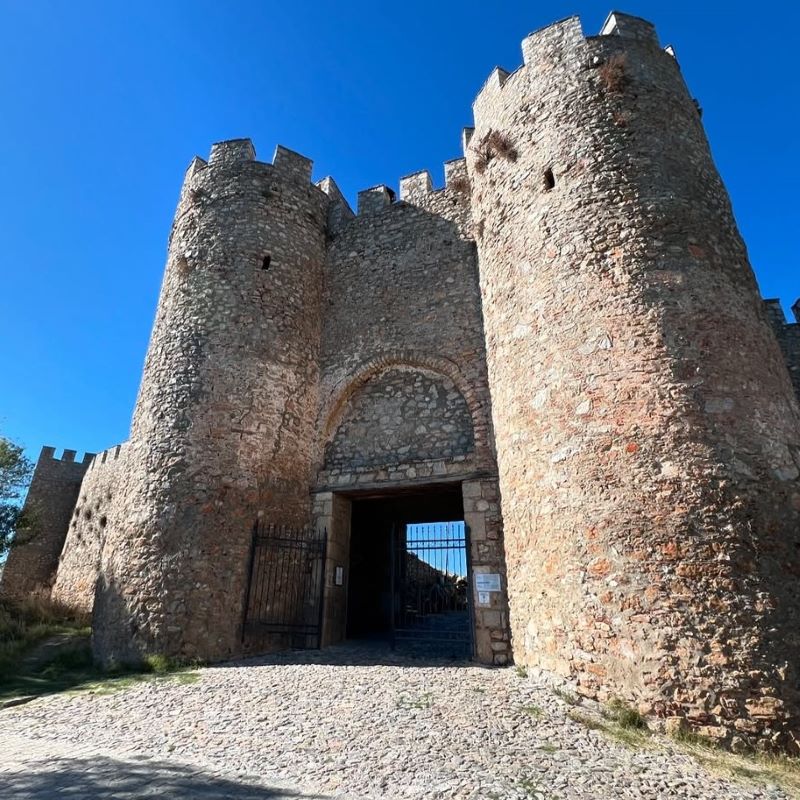
Samuel’s Fortress anchors the skyline and the historical imagination of Ohrid. The Institute and Museum in Ohrid describes it as one of the largest medieval fortification complexes in the country. Its walls and towers occupy the whole Ohrid hill, about 100 meters above the lake, and the defensive line stretches for roughly three kilometers toward the old port. The same official source also points to earlier fortification on the site and links the preserved medieval walls to the age of Tsar Samuel and his successors, when Ohrid served as an imperial center. For a visitor, the fortress does more than offer a view. It explains why this hill mattered to rulers, soldiers, and church leaders for so long.
The Ancient Theatre shows how deeply antiquity still lives here
A short walk below the fortress brings you to the Ancient Theatre, one of the clearest reminders that Ohrid began long before its medieval churches. The Ohrid museum says builders laid it out at the end of the 3rd century BC or the beginning of the 2nd century BC during the late Hellenistic period. After Rome took the region, the theatre changed with the times and gained an arena for gladiatorial combats and animal fights. The museum also notes that later rebuilding lifted the capacity to about 5,000 spectators. Today the site serves art again. Since 2001, performances have returned to the restored space, and the Ohrid Summer Festival still uses historic venues across the town, including St. Sophia and related old-town stages. That continuity gives the theatre unusual energy. Ancient stone still hosts live voices.
St. Sophia Cathedral holds one of Ohrid’s deepest artistic worlds
St. Sophia stands at the heart of Ohrid’s sacred and artistic heritage. Macedonia’s official tourism page describes it as a masterpiece of Byzantine architecture with fresco cycles from the 11th and 14th centuries. Google Arts & Culture, working with CyArk, adds that the paintings record four centuries of Byzantine achievement and that Archbishop Leo commissioned the earliest frescoes. Those early paintings also preserve some of the earliest surviving Byzantine images of St. Cyril of Salonika and St. Clement of Ohrid. This is why St. Sophia feels larger than a church visit. It works like a visual archive of the Ohrid Archbishopric and of the wider Byzantine world that shaped the city.
Plaoshnik brings together faith, learning, and archaeology
Plaoshnik may be the single place where Ohrid’s spiritual and intellectual story comes into sharpest focus. The Ohrid museum describes it as an exceptional archaeological complex with layers from prehistory, antiquity, and the Middle Ages. Excavations uncovered the remains of St. Clement’s church, his tomb, an early Christian basilica, and a baptistery whose mosaic floor still shows vines, birds, animals, and geometric forms. The museum also records the 2002 restoration of the church of St. Panteleimon and the later start of work on St. Clement’s University at Plaoshnik. Local cultural sources connect this hill directly with the Ohrid Literary School and the growth of Slavic literacy. When you stand at Plaoshnik, that history feels concrete. Teaching, worship, burial, archaeology, and restoration all meet on the same terrace above the lake.
St. John at Kaneo turns architecture into landscape
St. John at Kaneo has become the image people carry home from Ohrid, and the reason becomes clear the moment you reach the cliff. Macedonia’s official tourism page calls it a 13th century church perched above the water, while other tourism sources describe its mix of Byzantine and Armenian elements. Yet the church’s power does not come from style alone. Kaneo works because architecture and site speak in one voice. The stone church, the cypresses, the rock below, and the open lake behind it create a view that feels complete from every angle. A boat ride shows its dramatic position best, while the footpath from Plaoshnik lets you feel the slow reveal that makes the arrival so satisfying.
Holy Mother of God Peribleptos rewards careful looking
Peribleptos gives a different kind of reward. From outside, the church sits quietly within the old town fabric. Inside and in its art history, it opens into one of Ohrid’s key monuments. The Ohrid museum identifies the church as dating from 1295, and the Byzantine Legacy notes that the frescoes form the first documented work of Michael Astrapas and Eutychios, whose names appear in inscriptions on painted military saints. This matters for more than specialist art history. Peribleptos shows how Ohrid joined the larger currents of late Byzantine painting while still keeping its own local force. Visitors who slow down here begin to see what makes Ohrid’s monuments so rich. Their value often lies in detail, inscription, and surviving paint rather than size alone.
Walking between the monuments tells the story better than any map
Ohrid works best on foot because distance between monuments tells part of the story. The fortress, the theatre, Plaoshnik, Kaneo, St. Sophia, and Peribleptos all sit within a walkable historic core. As you move between them, the city reveals how ancient urban life, medieval faith, and later residential streets still fit together. UNESCO calls Ohrid’s architecture one of the best preserved and most complete ensembles of ancient urban architecture in this part of Europe. That statement comes alive in the lanes of Varosh, where the monuments never feel isolated. Each one leads naturally to the next.
Ohrid’s festivals keep the monuments alive
The monuments matter even more because the city still uses them as living cultural spaces. The Ohrid Summer Festival, founded in 1961, runs through the heart of summer and stages music and theatre programs in historic settings around the old town. Current festival listings show performances in and around St. Sophia, which confirms that the city still lets architecture shape the cultural experience. This living use changes how visitors see the monuments. They are not frozen shells from a closed past. They still frame sound, gathering, ritual, and public memory in the present.
How to plan a strong monument route in Ohrid
A smart route starts early and climbs steadily. Begin with the Ancient Theatre and Samuel’s Fortress while the light still falls softly across the hill. Continue to Plaoshnik and then walk down toward Kaneo, where the lake view gives the route a natural pause. Later, return through St. Sophia and Peribleptos, whose interiors reward slower attention once the city has fully opened for the day. The Ohrid museum provides direct phone contacts for the fortress and Plaoshnik, which helps if you want current site details before you set out. I could not confirm one current monument wide ticket list from an official source, so site by site checks remain the safest option.
Why Ohrid monuments stay with you
Ohrid stays in memory because the monuments do more than illustrate history. They create a continuous experience of it. The fortress gives scale and power. The theatre gives antiquity a human voice. St. Sophia and Peribleptos turn paint and stone into theology and art. Plaoshnik ties the city to St. Clement, learning, and Slavic literacy. Kaneo brings the whole story back to the lake and the cliff. UNESCO’s recognition of the Ohrid region for both natural and cultural value makes perfect sense once you walk this route. In Ohrid, land, water, faith, and learning still hold together.

Tours that include this place
Ohrid Highlights Trek

Walk Ohrid in 3–4h: pearl workshop, Robevi House, handmade paper, frescoed St. Sophia, ancient theatre, Samuel’s Fortress, Plaoshnik, and Kaneo’s cliff-top chapel.
Bay Bones Heritage

Full-day loop: stroll UNESCO Ohrid, explore Bay of Bones stilt village, boat St. Naum’s springs, and crest Galichica. Culture, nature, and archaeology braided beautifully.
Ohrid Bitola Legacy

Compare UNESCO Ohrid’s churches and fortresses with Bitola’s mosques, bazaar, and Heraclea mosaics. Two cities, one 11h story of trade, faith, and empire.
Struga Radožda Vevčani

From Ohrid’s icons to Struga’s Poetry Bridge, climb Radožda’s cliff-chapel, then wander Vevčani’s springs and workshops. A gentle 10h day of waters, villages, and views.