
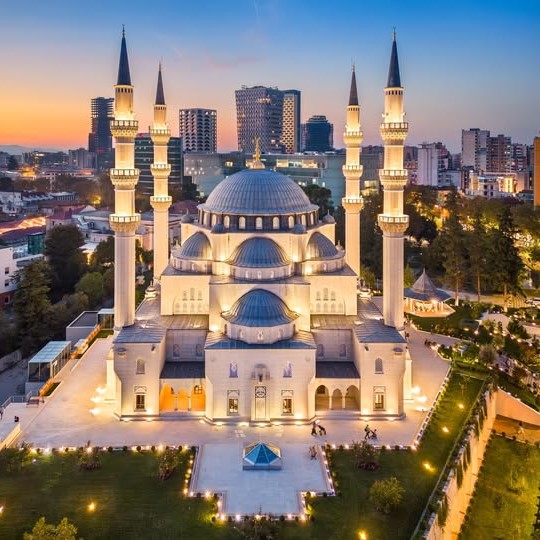
Why Tirana surprises first-time visitors
Tirana often catches people off guard. You arrive expecting a compact Balkan capital and find a city that feels energetic, layered, and very alive. The center brings together Ottoman memory, Italian-era geometry, communist landmarks, fresh public spaces, cafés, markets, and a young crowd that gives the city a restless pulse. The municipality’s own tourism material describes Tirana as a place where church bells and the call to prayer share the same urban space, and where medieval, fascist, communist, and contemporary architecture stand side by side. That description captures the city well because Tirana makes its contrasts visible instead of hiding them.
That mix gives Tirana its appeal. You can begin the day in a square shaped by national symbolism, step into an Ottoman mosque, walk past an Italian ministry block, descend into a Cold War bunker museum, and end the evening in a district once reserved for communist leaders and now known for bars, cafés, and nightlife. Few capitals in the region tell their story so openly through the streets themselves.
How Tirana grew from an Ottoman town into Albania’s capital
Modern Tirana dates to 1614, when Sulejman Bargjini Pasha founded the town by building a mosque, a bakery, and a hamam around a market core. Official Tirana sources present that moment as the start of the modern city, even though the plain had older settlements long before that date. The early urban idea was practical and commercial. A market town made sense here because the Tirana plain linked mountain resources, rural production, and inland movement.
The city changed sharply after 1920, when Tirana became Albania’s capital. Visit Tirana explains that the center only began to look like a capital in the late 1920s under Italian influence. Architects such as Florestano di Fausto and Armando Brasini shaped the main square, the boulevard, the ministries, and the formal administrative core. That period gave Tirana a cleaner, more monumental face, and you can still read it clearly around Skanderbeg Square and the main central axis.
Later decades added another strong layer. Communist planning altered the square, introduced new public buildings, and filled the city with socialist apartment blocks and state monuments. After 1990, Tirana entered another period of fast growth and visual change. Official city sources describe bright façades, new public art, and wide urban transformation as part of modern Tirana’s identity. That is why the city now feels so mixed in the best sense. Every era left something behind, and the center still carries all of them at once.
Skanderbeg Square explains the city in one glance
The right place to begin is Skanderbeg Square. It is the symbolic heart of Tirana and the point where the city’s historical layers come into focus. Visit Tirana describes it as the starting point of every first visit and notes that the buildings around it represent different phases of Albanian history. On one side you see Et’hem Bey Mosque and the Clock Tower. Around them stand Italian-era administrative buildings from the 1920s and 1930s. Nearby, the National Historical Museum façade adds the monumental language of the communist period.
The square works well because it gives newcomers orientation and context at the same time. The statue of Skanderbeg anchors the national story. The mosque and tower show the older Ottoman city. The ministries and broad urban lines show the interwar capital. The museum façade and Palace of Culture recall the socialist period. In one short walk, Tirana explains itself.
Et’hem Bey Mosque deserves real attention, even if you only spend a short time inside. Official Tirana tourism material says Molla Bey began the mosque in 1794 and Haxhi Et’hem Bey finished it in 1821. It is the only one of Tirana’s eighteenth- and nineteenth-century mosques that still stands, and its painted decoration makes it one of the city’s key monuments. Right beside it, the Clock Tower completes one of the best-known architectural pairs in the Albanian capital.
The city center feels compact because the key sights cluster together
Tirana rewards walking. The official city map places the National Historical Museum, Bunk’Art 2, the National Gallery, the Clock Tower, Et’hem Bey Mosque, the Pyramid, and the Blloku area within a tight central zone. The municipality’s mobility guide also frames the center as a city to explore on foot, with linked districts and short transitions between major sites. In practice, that means you can cover a lot without spending the day inside transport.
That compact feel matters for visitors with limited time. Tirana can work as a quick day-trip capital, yet it also rewards a full weekend because each short walk leads into another layer. One street gives you Ottoman remains, the next leads to Italian-era facades, and a few minutes later you reach contemporary art, nightlife, or a market lunch. The city feels manageable, but it never feels flat.
Bunk’Art 2 and the Pyramid show how Tirana handles its recent past
Tirana does not hide the twentieth century. It puts it in front of you and asks you to look closely. Bunk’Art 2 is one of the clearest examples. Official sources describe it as a museum inside the former anti-atomic shelter of the Ministry of Interior, built between 1981 and 1986. The museum tells the story of the Albanian Ministry of Interior from 1912 to 1991 and includes a major exhibition on victims of communist terror. Another official Bunk’Art page describes it as a real bunker in the heart of Tirana, once used by the Ministry of Internal Affairs during the dictatorship.
A short walk away, the Pyramid carries a different tone. It began in 1988 as a museum for Enver Hoxha. Today it has a new life. MVRDV describes the renewed structure as an open cultural hub in a public park, while official Tirana material says it now functions as Albania’s largest youth technology center, with digital education, art, culture, workshops, and public space. That transformation says a lot about Tirana. The city keeps difficult buildings, but gives them new uses instead of letting them freeze in one meaning forever.
Blloku and the New Bazaar show the social side of the city
Blloku gives you one of Tirana’s clearest before-and-after stories. During the communist period, ordinary people could not enter this area freely because the political elite lived there. Official Tirana sources describe it as an off-limits district before the 1990s and note that Enver Hoxha’s residence stood here. Today, the same area mixes villas, towers, boutiques, cafés, and clubs, and Visit Tirana presents it as a leading zone for cafés, restaurants, and nightlife. That shift from restricted district to social hotspot captures the spirit of post-1990 Tirana very well.
The New Bazaar adds another side of the city. Official Tirana material says the bazaar dates to 1931 and now works as a multifunctional food and event space with restaurants, fairs, performances, and culinary activity. This makes it one of the easiest places to understand modern Tirana as a city of everyday energy rather than monuments alone. Come here for produce, grilled food, coffee, or a slower lunch, and you feel the city’s local rhythm in a very direct way.
Food helps explain Tirana just as much as architecture does. The city has a strong café culture, and visitors notice it fast because the tables seem to flow through every district, from the square to Blloku to the streets around the Pyramid. For breakfast, byrek with cheese gives you the simple, reliable start that locals know well. Later in the day, espresso, small plates, and a longer pause fit the city better than a rushed sit-down plan. Tirana likes movement, but it also likes lingering.
Dajti gives the capital breathing room and a wider view
Tirana’s geography matters because Mount Dajt rises right behind the city. Official tourism sources describe the capital as standing at the foot of Dajt, and that close mountain presence gives the city a useful contrast. One moment you are in traffic, markets, and public squares. The next, you can head uphill for air, trees, and a much wider view over the plain.
Dajti Ekspres makes that escape easy. The official cable car site says visitors can reach the lower station from central Tirana by the Porcelan bus, which departs near the Clock Tower by Skanderbeg Square and usually takes about 20 to 30 minutes, depending on traffic. Visit Tirana adds that the cable car ride itself lasts about 15 minutes and gives sweeping views over the capital. This is one of Tirana’s strongest advantages as a city break. Nature sits close enough to feel like part of the same day rather than a separate trip.
Why Tirana works so well for a short trip
Tirana works well because it does not force one identity on the visitor. It is a capital, yet it still feels personal. It has a heavy history, yet it moves with youthful confidence. It values cafés, markets, and night streets just as much as museums and monuments. Official guides present it as a city that never sleeps, and while that phrase sounds promotional, it points to something real. Tirana carries momentum. You feel it in the late coffee, the busy squares, the constant building, and the way old structures keep finding new uses.
For that reason, Tirana deserves more than a fast border-capital stop. Start in Skanderbeg Square, look closely at the mosque and the surrounding architecture, spend time with the city’s recent past in Bunk’Art 2 and the Pyramid, eat your way through the New Bazaar or Blloku, and save room for Dajti if the weather is clear. That route gives you the city’s core story in the right order. Tirana then fills in the rest through atmosphere, conversation, and the quick transitions that make the capital feel so alive.

Tours that include this place
Tirana Capital Dash

Dash from Bitola to Tirana for Skanderbeg Square, Bunk’Art bunker museum, and the lively New Bazaar. Street art, history, espresso culture—and mountain sunsets—packed into 14 energetic hours.
Tirana Day Dash

Trade lake calm for Tirana’s murals, Bunk’Art bunker museum, and New Bazaar flavors; return via Elbasan fortress and an Ohrid stroll. A lively 12h cross-border capital sprint.