
Moskopole: Churches, Monasteries, Frescoes, and the Mountain Village That Once Shaped the Balkans
Moskopole, now widely called Voskopoja, leaves a very different impression from the first few minutes. The road rises out of Korça, the air cools, the buildings grow quieter, and the village settles into a broad mountain landscape that feels older than the present day. You arrive in a small Albanian village, yet the place carries the memory of a much larger world. In the eighteenth century, Moskopole stood among the key cultural and religious centers of the Balkans. Today, that past survives in stone churches, fading frescoes, monastic courtyards, and a village atmosphere that still feels thoughtful, serious, and deeply rooted.
Why Moskopole matters far beyond its size
Moskopole matters because it once did far more than serve a local mountain district. Official Albanian tourism material presents it as one of the important urban centers of the Balkans in its period of growth, with links reaching cities such as Venice, Vienna, Budapest, and Leipzig. The same source points to an academy, a library, and an early printing house that helped turn the town into a place of learning as well as trade. The World Monuments Fund adds that 26 churches rose here between 1630 and 1780 along a trade route connecting Venice and Constantinople. This is why Moskopole feels larger than its present scale. The village you see today grew from a city that once moved ideas, books, faith, and commerce across a broad region.
That wider story gives the village a rare kind of depth. In a lot of mountain destinations, scenery leads the visit and history follows later. In Moskopole, the opposite often happens. The churches and the old intellectual legacy shape the experience first, and the landscape then strengthens what you already feel. You stand in a quiet plateau settlement and begin to understand that this was once a place where language, religion, art, and education met in unusually rich ways for a town in the Ottoman Balkans.
Where Moskopole sits and how the setting shapes the visit
The village lies about 20 kilometers west of Korça in southeastern Albania at around 1,160 to 1,200 meters above sea level. That elevation matters. It gives Moskopole a fresher climate, a slower rhythm, and a mountain feel that sets it apart from the plain below. Official tourism pages highlight the village’s stone houses, cobbled streets, and pine landscape, and those three elements define the visit very clearly. You move through a place where architecture and nature still fit together in a natural way.
The setting also helps explain why the village works so well today as a half-day or full-day trip from Korça. The road climbs into the Morava foothills, and the shift in atmosphere starts before you even arrive. Down in town, Korça gives you boulevards, museums, and urban energy. Up here, Moskopole gives you silence, fresher air, church courtyards, and the kind of mountain calm that makes people slow their pace without planning to. That contrast is one of the village’s strongest assets.
A place shaped by learning, faith, and post-Byzantine art
Moskopole’s strongest identity came from the way it joined trade with scholarship and religious life. Albanian tourism material describes it as home to an academy, a library, and the first printing house in the Balkans in 1720, while local Voskopoja cultural sources describe the town’s craft guilds as investors in education and the spread of ideas through the New Academy and the printing press. Even if exact dates and peak figures vary across sources, the broad point remains clear. Moskopole was not only prosperous. It used that prosperity to build a real intellectual life.
That legacy still matters for visitors because it changes how the churches read. These are not isolated religious buildings in a remote village. They belong to a place that once supported readers, scholars, icon painters, clergy, and networks of exchange across the Balkans. When you look at a painted wall here, you are also looking at the remains of a community that valued learning enough to build institutions around it. That gives Moskopole a richer feel than a village known only for scenery or only for worship.
The Church of St Nicholas gives Moskopole its clearest visual identity
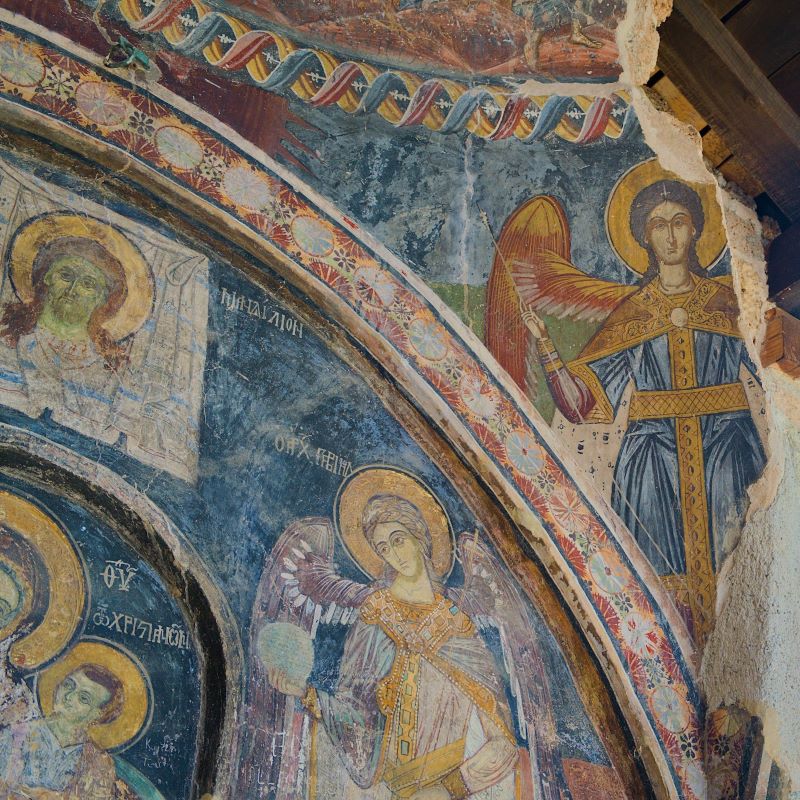
If one monument captures the spirit of Moskopole, it is the Church of St Nicholas. Albanian tourism material dates it to 1721, and Visit Korça describes the village’s churches as some of the finest examples of post-Byzantine art in Albania. The national religious heritage page also names David Selenicasi and the Zografi brothers among the painters connected with the fresco tradition of the village. This matters because St Nicholas is not just an old church. It stands at the center of the village’s artistic reputation.
The appeal of St Nicholas comes from the way architecture and painting work together. From the outside, the church feels solid and restrained. Inside, the painted surfaces and iconographic program carry the emotional weight. Even if a visitor knows very little about Orthodox art, the effect is immediate. The frescoes bring color, narrative, and solemnity into a mountain setting that already feels removed from daily noise. This is why photographers, art lovers, and first-time visitors all tend to remember the church so clearly. It offers beauty, but it also offers concentration.
Morning light tends to help here. As the sun rises higher, it gives more shape to wall surfaces, porches, and painted details. That is one reason an early start from Korça works so well. You reach the village while the churches still feel quiet, the air still feels cool, and the art still holds the clear, soft light that makes old stone and old color easier to read.
The Monastery of St John the Baptist adds silence and distance
The Monastery of St John the Baptist, often called Shën Prodhromi, adds a different mood to the visit. Official Albanian tourism sources date the monastery to 1632, and the same heritage material states that painters later decorated the church in 1659. This makes it older than the village’s eighteenth-century peak and gives it a special place in the wider story of Moskopole. It feels less urban and more withdrawn, more like a place of seclusion than of public prestige.
That difference matters. St Nicholas speaks of a flourishing town with artistic ambition. The monastery speaks of continuity, prayer, and the longer religious life of the landscape itself. Visitors often respond strongly to that shift because the monastery sits a little apart from the center and asks for a quieter pace. The moment you step into its grounds, the whole visit changes from village exploration to a more inward kind of experience. Stone walls, trees, and the smaller scale of monastic space all work together to slow the eye and steady the mood.
The monastery also reminds you that Moskopole still belongs to living religious life, not only to heritage tourism. That is why modest clothing and a calm tone fit the setting well. A place like this welcomes visitors best when they move with a little patience and a little respect. In return, it offers something harder to find in larger destinations, a real sense of continuity between past devotion and present atmosphere.
Walking the village means reading layers rather than checking sights
Moskopole works best when you stop chasing only named sights and start reading the village as a whole. Official tourism pages highlight traditional stone architecture, cobbled streets, and pine forest surroundings, and that combination tells you a lot about how to move through the place. A slow walk reveals more than a fast circuit ever could. One church leads to a lane, the lane opens to a view, the view leads to another wall painting, and the whole village starts to feel like a sequence of connected spaces rather than a set of isolated stops.
This also explains why the historical memory of the New Academy still matters even if the visitor today does not find a single grand preserved academic building at the center of the route. The academy survives first as part of the village’s identity. It tells you what kind of place Moskopole once was. You do not need a reconstructed classroom to feel that. The surviving churches, the traces of an older urban scale, and the intellectual reputation recorded in Albanian and local cultural sources already do the work.
Aromanian memory still shapes how people talk about Moskopole
Moskopole also carries a strong place in Aromanian memory. Historical summaries widely describe it as a leading Aromanian cultural center in the eighteenth century, and local Voskopoja cultural sources describe the old town as shaped by both Vlach and Albanian communities. This part of the story matters because it explains why Moskopole stands out in the Balkans as more than a church village. It belongs to a wider network of identity, language, migration, and memory that still gives the place meaning far beyond Albania alone.
You can feel that layered identity in the village’s names as well. Voskopoja, Moskopole, and Moscopole all circulate in travel and historical writing. That variety reflects the mixed cultural world that shaped the town through the centuries. Rather than reducing the place to one neat label, it makes more sense to see Moskopole as a crossroads. That is part of its appeal. The village grew at the meeting point of communities, languages, and religious traditions, and that richness still gives the visit its character.
How to plan a rewarding visit from Korça
A half day from Korça works very well here. The short mountain drive keeps the trip easy, and the compact village layout lets you combine major churches, the monastery, and a relaxed walk without strain. Official tourism pages from Albania and the Korça area both frame Voskopoja as one of the key mountain destinations near the city, which matches the experience on the ground. Start in the morning, visit St Nicholas while the light feels gentle, continue to the monastery, and then leave room for lunch or tea before heading back down.
Cash is a smart idea for small purchases, and a simple, respectful outfit works well for church interiors. The village rewards shoes that handle stone and uneven ground with ease. After that, the main requirement is time. Moskopole opens best to travelers who move slowly, look closely, and allow the churches and the landscape to speak at their own pace.
Why Moskopole deserves more than a quick church stop
Moskopole deserves more than a quick visit because it offers something rare in the region. It gives you mountain quiet, but also Balkan scale. It gives you village calm, but also the memory of a city that once helped circulate books, ideas, and sacred art across a wide world. A lot of places have old churches. Far fewer places can show how those churches grew out of a community that also built an academy, a library, and an early printing culture.
That is why Moskopole stays with people. The frescoes matter. The monastery matters. The road up from Korça matters too. Yet what really lasts is the feeling that this quiet village once stood at the center of a larger Balkan story and still carries that weight with grace. For travelers who want history, art, and mountain atmosphere in the same place, Moskopole gives a full and memorable answer.

Tours that include this place
Korça Moskopole Monasteries

Korça stroll and cider, Moskopole’s 18th-century frescoes, and a Galichica picnic viewpoint. A serene 12-hour day of monasteries, scenery, and quiet stories.
Korça Ohrid Heritage

Korça cafés, Moskopole monasteries, lunch in Pogradec, then St. Naum and Bay of Bones before golden-hour Ohrid. A rich 14-hour cross-border cultural arc.
Bitola Korça Loop

Bitola heritage, Korça boulevards, Moskopole murals, Pogradec lunch, St. Naum springs, and Galichica ridge views. Thirteen hours, two lakes, many eras.
Balkan Heritage Trail

Cross-border loop from Bitola to Korça, Moskopole’s monasteries, Pogradec, Struga, and UNESCO Ohrid. Pearls, frescoes, lakeside views, and fortress panoramas in one well-paced 14-hour day.