
Saranda: Albania’s Ionian Jewel Where History Meets the Sea
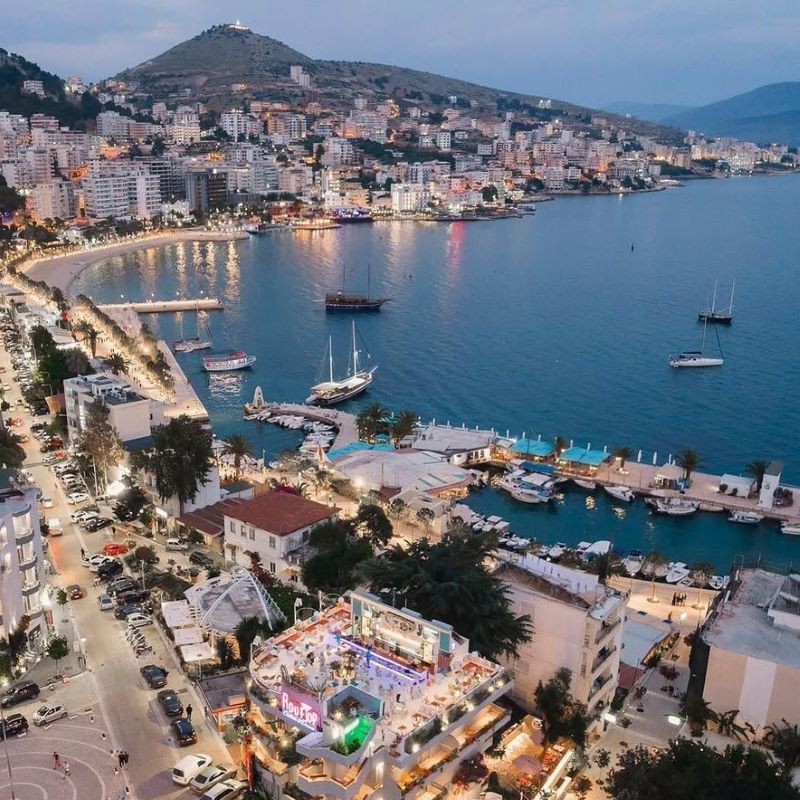
On the southern coast of Albania, where the Ionian Sea laps against a shore blessed with more than three hundred days of sunshine each year, the city of Saranda spreads across a hillside amphitheater. The water here holds a color that seems borrowed from the Caribbean, turquoise and clear, revealing the white sand below. Across the strait, the Greek island of Corfu floats on the horizon, close enough to reach by hydrofoil in half an hour. Saranda has grown from a quiet fishing village into the jewel of the Albanian Riviera, a place where ancient ruins, modern cafes, and natural wonders combine to create one of the Mediterranean’s most appealing destinations.
The story of Saranda reaches back more than two thousand years. The ancient Greeks knew this place as Onhezmos, a trading post and port city founded in the 2nd century BC. Illyrian tribes inhabited the surrounding hills, trading with the Greek colonists who established themselves along the coast. The Romans came later, incorporating the city into their empire and developing it as a staging point for trade across the Adriatic. The name Saranda, however, comes from a later period. Local tradition holds that the city took its name from the Monastery of the Forty Saints, Agioi Saranta in Greek, built here in the 4th to 6th centuries to honor forty Christian martyrs who died for their faith in Armenia.
The Monastery of the Forty Saints
Above the modern city, on a hill overlooking the sea and the island of Corfu, the ruins of the Monastery of the Forty Saints stand as a testament to Saranda’s long Christian history. The monastery dates from the early Byzantine period, when Christianity spread rapidly through the coastal cities of the empire. Pilgrims came to honor the forty martyrs, soldiers of the Roman army who refused to renounce their faith and suffered death by exposure on a frozen lake in Armenia. Their story resonated with early Christians, and churches dedicated to them appeared across the Byzantine world.
The climb to the monastery rewards you with panoramic views that stretch across Saranda, the bay, and the mountains of Corfu. The ruins themselves, though fragmentary, convey the scale and importance of the original complex. Archaeologists continue to work here, uncovering new details about the layout and history of the site. The monastery gave Saranda its name, and standing among its stones connects you to the deepest layers of the city’s identity.
Butrint: The Layers of Civilization
Eighteen kilometers south of Saranda, Butrint National Park preserves one of the most important archaeological sites in the Balkans. UNESCO recognized Butrint as a World Heritage site in 1992, acknowledging its unique value as a record of Mediterranean civilization spanning more than three thousand years. The Greeks founded a colony here in the 7th century BC, recognizing the strategic value of the location on a hill surrounded by water and wetlands. They built a theater, temples, and defensive walls, some of which survive today.
The Romans conquered Butrint in the 2nd century BC and transformed it into a prosperous provincial city. They added baths, a forum, an aqueduct, and a new theater. The Roman phase of Butrint produced some of the site’s most impressive remains, including a well-preserved mosaic floor in the baptistery and the massive walls that still encircle much of the ancient city. After the fall of Rome, Butrint continued under Byzantine rule, then passed to the Normans, the Venetians, and the Ottomans. Each period left its mark, creating a palimpsest of civilizations that archaeologists continue to decipher.
Walking through Butrint today means walking through all these layers at once. You enter through a Venetian tower, pass a Roman bathhouse, climb the steps of a Greek theater, and stand before a Byzantine baptistery. The setting adds to the power of the experience. The site sits within a national park of wetlands and forests, home to birds, turtles, and other wildlife. The combination of nature and history makes Butrint unique, a place where you feel the weight of time while surrounded by living beauty.
The Blue Eye
Twenty-five kilometers northeast of Saranda, the landscape changes from coastal to mountainous. Here, in a forested valley, one of Albania’s most extraordinary natural wonders emerges from the earth. The Blue Eye, known in Albanian as Syri i Kaltër, is a karst spring of astonishing beauty and power. Water rises from a deep fissure in the limestone, creating a pool of such intense blue that it seems to glow from within. The exact depth of the spring remains unknown, but divers have descended more than fifty meters without reaching the bottom.
The water temperature holds constant at about 10 degrees Celsius year-round, a shock to swimmers accustomed to the warm Ionian Sea. The bravest visitors lower themselves into the pool, gasping at the cold while watching the sand boil up from the depths where the water emerges. The surrounding forest provides shade and picnic spots, and wooden walkways allow you to approach the spring without damaging the delicate ecosystem. The Blue Eye draws crowds throughout the summer, but the wonder of the place survives the attention. Standing at the edge of that impossibly blue water, watching it rise from the darkness below, you understand why Albanians consider this one of their country’s greatest treasures.
Ksamil and the Islands
Just south of Butrint, the village of Ksamil has become famous for its turquoise waters and tiny islands. The coast here features white sand beaches and shallows that stay warm throughout the summer. Four small islands sit just offshore, accessible by boat or, at low tide, by swimming. Local fishermen offer boat transfers for about five euros, taking you out to the islands where you can claim your own private cove for the day.
Pulebardha beach, on one of the islands, ranks among the most beautiful in Albania. The sand here is fine and white, the water so clear that you see fish swimming around your feet. Sunbeds and umbrellas line the more developed sections of the coast, but the islands offer a more natural experience. You can spend the day swimming, snorkeling, and exploring the rocky shores, returning to the mainland only when the sun begins to set.
Ksamil has developed rapidly in recent years, with hotels and restaurants springing up along the waterfront. The development has brought crowds, especially in July and August, but the beauty of the place survives the commercialization. Arriving early in the morning or visiting in the shoulder seasons of May-June and September-October allows you to experience Ksamil at its best, with the water still warm and the crowds still manageable.
The Synagogue and the Jewish Heritage
In the center of Saranda, excavations have revealed something unexpected and precious. The ruins of a 5th to 6th century synagogue, with its mosaic floor still intact, represent the only ancient synagogue discovered in Albania. The mosaic features geometric patterns and images of menorahs, evidence of a Jewish community that flourished here during the late Roman period. The synagogue continued in use until the 6th century, when it was converted into a church, reflecting the changing religious landscape of the Byzantine Empire.
The discovery of this synagogue adds a new dimension to Saranda’s history. It reminds us that this coast has always been a meeting place of cultures and faiths, a crossroads where people of different backgrounds lived together. The site remains open to visitors, the ancient mosaics protected by a modern shelter. Standing before those menorahs, worked in colored stone fifteen hundred years ago, you feel the presence of a community long vanished but not forgotten.
Lekuresi Castle and the Sunset View
Above Saranda, on a hill that commands the entire bay, the castle of Lekuresi watches over the city and the sea. The Ottomans built this fortress in the 16th century, following their conquest of the region. They positioned it to control the approaches to Saranda and to monitor shipping between the mainland and Corfu. The castle never faced a major siege, but it served its purpose as a symbol of Ottoman power for centuries.
Today, the castle houses a restaurant that draws visitors for one of the finest sunset views in the Mediterranean. From the terrace, you look down on Saranda spread along the coast, across the strait to Corfu rising from the sea, and out to the infinite horizon where the sun sinks into the Ionian. The restaurant serves traditional Albanian dishes alongside international options, and the combination of good food and spectacular setting makes for an unforgettable evening. Arriving early allows you to explore the castle walls before claiming your table for the sunset show.
The Promenade and Café Culture
The heart of modern Saranda beats along its marble promenade. This 1.5 kilometer walkway follows the curve of the bay, lined with palm trees, cafes, restaurants, and boat kiosks. In the evening, the promenade fills with families, couples, and friends taking the xhiro, the traditional Albanian evening stroll. The pace slows, conversations flow, and the whole city seems to exhale after the heat of the day.
Cafes along the promenade serve strong Albanian espresso, frappes for the younger crowd, and cocktails as the evening deepens. Noname, a popular bar right on the water, draws a lively crowd with its music and atmosphere. Boat operators offer trips to the Ksamil islands, to hidden coves along the coast, and across to Corfu. The promenade serves as the stage for Saranda’s social life, a place where visitors and locals mix in the warm Mediterranean evenings.
Pasqyra Beach and the World’s Bluest Waters
Just south of Saranda, Pasqyra Beach has earned a reputation that draws visitors from across the region. The name means “mirror” in Albanian, and the water here reflects the sky with such clarity that the distinction between sea and air seems to disappear. Some travelers claim this beach holds the world’s bluest waters, a bold assertion in a region of bold assertions. The color defies description, a shade of turquoise so intense that photographs seem exaggerated.
The beach sits at the base of cliffs, accessed by a road that winds down from the main coastal highway. Arriving before ten in the morning secures the best loungers and a spot on the prime section of sand. The water stays shallow for some distance, warming quickly in the morning sun. Snorkelers find fish among the rocks at the edges of the bay. The setting, with cliffs rising behind and the open sea ahead, creates a sense of seclusion despite the crowds that gather here.
The Çam and Lab Traditions
Saranda sits at the heart of a region with distinct cultural traditions. The Çam and Lab communities, with their own dialects, music, and costumes, have inhabited these mountains and coasts for centuries. The Ethnographic Museum in Saranda displays examples of traditional dress, with the elaborate costumes of the Çam women and the distinctive white wool garments of the Lab shepherds. These textiles, embroidered with patterns passed down through generations, represent an artistic tradition that continues today.
The music of this region differs from the folk music of northern Albania. The polyphonic singing of the south, with its overlapping voices and drone accompaniment, creates a sound that seems to rise from the landscape itself. During festivals and celebrations, you might hear this music performed live, the voices echoing off the hills in a tradition that goes back centuries.
The Corfu Connection
Saranda’s location opposite Corfu has shaped its history and its present. The island appears on the horizon, close enough to swim on a calm day though the currents make that inadvisable. Hydrofoils make the crossing in thirty minutes, ferries in about an hour, connecting Albania and Greece in a way that feels natural given the proximity. Many visitors to Saranda include a day trip to Corfu in their itinerary, experiencing the Venetian elegance of Corfu Town and returning to the Albanian coast by evening.
The connection runs deeper than tourism. Families have members on both sides of the strait, and the movement of people between the two countries continues despite the border. The cuisine reflects this mixing, with Greek influences appearing alongside Albanian traditions. The sense of being at a crossroads, of belonging to both worlds, pervades Saranda and gives it a distinctive character.
Practical Saranda
Getting to Saranda requires either a drive from other parts of Albania or a ferry from Corfu. The road from Tirana takes four to five hours, passing through mountains and along the coast in a journey that reveals the beauty of the Albanian landscape. Ferries from Corfu run regularly during the summer, making Saranda an easy extension of a Greek island holiday. Within Albania, buses connect Saranda with Butrint, Tirana, and other cities, offering an inexpensive way to travel.
The currency remains the Albanian lek, though many businesses accept euros, especially those catering to tourists. Markets and small shops prefer cash, while hotels and larger restaurants accept cards. The exchange rate hovers around 98 to 100 lek per euro, and checking rates before exchanging prevents misunderstandings. Sunbeds on the beaches rent for four to twenty euros depending on location and season, a modest cost for a day of comfort by the sea.
The best times to visit Saranda are May through June and September through October. The weather during these months averages 27 degrees Celsius, warm enough for swimming but not so hot as to overwhelm. The crowds of July and August have not yet arrived or have already departed, leaving the beaches and attractions more accessible. The water stays warm through October, extending the swimming season well into autumn.
As the sun sets over Saranda, turning the sea to gold and the sky to rose, you understand why this place has drawn people for three thousand years. The Greeks, the Romans, the Venetians, and the Ottomans all recognized the value of this coast. Today, a new generation discovers what they knew, that Saranda offers something rare in the Mediterranean, a combination of history, nature, and culture that welcomes the world without losing its soul. The promenade fills with strollers, the cafes buzz with conversation, and the sea stretches toward Corfu in the fading light. Saranda waits for you to join the dance.

Tours that include this place
Saranda Riviera Escape

Three-day escape via Florina, Ioannina and Parga to Sarandë. Sunset bays, UNESCO Butrint, Blue Eye spring, Ksamil beaches, and alpine Metsovo—coast, culture, and peaks.
Saranda Meteora Odyssey

Road-trip via Florina, Metsovo, Ioannina and Parga to Sarandë. See Butrint, Blue Eye, Ksamil, then marvel beneath Meteora’s cliff monasteries. A curated 3-day odyssey.