
Bay of Bones Museum Guide: Prehistoric Life on Lake Ohrid
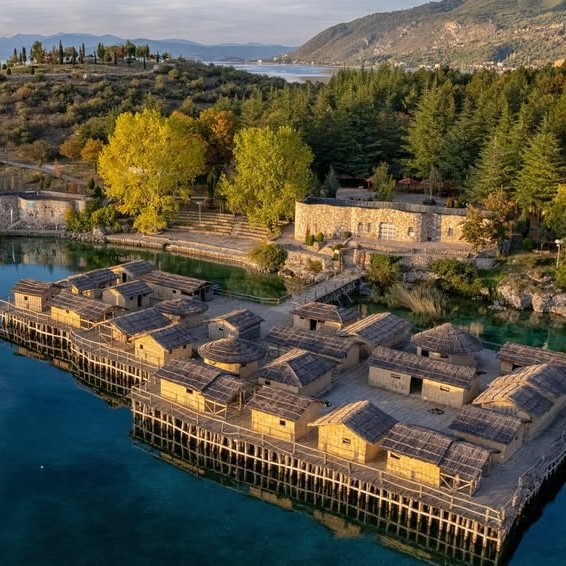
Bay of Bones Museum gives you one of the clearest windows into early life on Lake Ohrid. The site sits on the southern coast of the Gradishte peninsula near the village of Peštani, where archaeologists found the remains of a prehistoric pile-dwelling settlement below the lake surface. Today, visitors walk through a reconstructed settlement on timber stilts, visit a small exhibition space, and climb to a Roman fort on the hill above. That mix makes Bay of Bones more than a scenic stop. It gives travelers a simple and memorable way to understand how people lived here long before medieval Ohrid, churches, and lakeside tourism shaped the region we know today.
The setting plays a huge role in that experience. The museum lies within the wider natural and cultural heritage of the Ohrid region, which the local heritage institution describes as a place of outstanding universal natural, cultural, and historical value. That context matters because Bay of Bones stands within a landscape where nature and human settlement have shaped each other for thousands of years. When you arrive, you see calm water, wooded slopes, and a narrow shore. Then the wooden huts come into view, and the whole scene starts to make sense. People settled here because the lake fed them, protected them, and connected them to the wider area.
The Story Behind the Site
The site’s deeper name is Ploča Mičov Grad, and its archaeological importance grew through underwater research campaigns that ran from 1997 to 2005. The Museum Ohrid page explains that these campaigns helped establish underwater archaeology in Macedonia as a formal branch of archaeological work. Researchers documented about 6,000 wooden piles at a depth of three to five meters, along with ceramic vessels, flint and stone objects, bronze finds, animal bones, and other traces of daily life. The remains belong to a late Bronze Age and early Iron Age settlement, which places the site deep in prehistory and far earlier than the classical and medieval landmarks that draw so much attention around Ohrid.
That research matters because Bay of Bones does not stand on guesswork or theme-park fantasy. It grew out of real evidence under the water. The official site says archaeologists measured the settlement at roughly 8,500 square meters and recorded its position only about ten meters from shore, stretching 155 meters east to west and 55 meters north to south. They concluded that a common wooden platform once stood above the lake, supported by piles driven into the lakebed, with a wooden bridge linking the settlement to land. Those details help visitors picture the original community in clear physical terms. This was a real settlement with structure, planning, and everyday routines shaped by the water.
The museum complex that visitors see today took shape in 2007 and 2008, when the settlement underwent reconstruction after those years of research. That matters for travelers because the site turns technical archaeological findings into something visual and easy to grasp. Instead of staring at drawings or reading dense panels, you can step onto the timber walkways and read the space with your own eyes. You understand the height above the water, the closeness of the huts, and the way a lakeside community balanced shelter, movement, and access to food. The reconstruction gives the site its power. It takes distant prehistory and brings it within reach.
What You See When You Arrive
The first thing that catches your eye is the reconstructed settlement itself. The complex includes 24 reconstructed prehistoric huts on a wooden platform over the lake, and that image has become one of the signature views of the Ohrid shoreline. Reed roofs, timber frames, and narrow walkways give the museum a strong sense of place. It feels simple, rough, and practical, which suits the subject well. This was a world built from local materials and shaped by function. Even if you arrive with little background knowledge, the layout explains a lot on its own. People here lived close to the water, used wood as their core building material, and organized life around a shared platform rather than a scattered dry-land village.
Walking the causeways helps you understand the settlement in a physical way. The boards creak, the lake reflects the huts from below, and the shore always stays within sight. That short distance between land and water tells part of the story. The settlement stood close enough to shore for access, yet far enough out to use the lake as a protective and practical setting. The official site also notes that researchers found circular ceramic objects that may have served as fishing tools, fragments of hand grinders for wheat, animal bones, deer antlers, and other household items. Those finds give shape to daily life. People here fished, processed food, used tools, and managed a working household rather than a symbolic outpost.
Inside the complex, the permanent exhibition helps bridge the gap between reconstruction and evidence. The museum page lists a museum object with showcases as part of the site, along with a base for underwater archaeology and development of underwater tourism. That gives Bay of Bones a wider purpose than simple display. The site preserves finds, explains the archaeological work, and links visitors to the process of discovery under the lake itself. This educational layer matters because it shows how archaeologists turned piles, fragments, and submerged traces into a fuller picture of ancient life on the Ohrid shore.
The Hilltop Roman Fort Adds a Second Layer of History
Bay of Bones also rewards visitors who keep climbing. Above the prehistoric settlement, on the flattened upper part of Gradishte hill, stands a Roman fort that the official museum text describes as a fortress or Roman castle from the 3rd century AD. This feature gives the site a second historical layer and changes the rhythm of the visit. You begin with prehistoric life close to the water, then move uphill into a later military landscape shaped by visibility and control. In one compact stop, you pass from domestic life in deep prehistory to Roman strategy in late antiquity.
That climb also sharpens your sense of geography. From the fort area, the peninsula, the shore, and the broad surface of Lake Ohrid line up in a way that makes the site easier to understand. You can see why people chose this location across different eras. The prehistoric community used the lake edge for shelter and subsistence. The Roman presence used height and view. The museum complex itself connects those two stories in a very direct way. Few sites around Ohrid bring together housing, landscape, defense, and archaeology with such clear visual logic.
What Bay of Bones Teaches About Prehistoric Daily Life
The real value of Bay of Bones lies in what it teaches so simply. A visitor does not need a background in archaeology to learn from this place. The site shows that prehistoric communities on Lake Ohrid built with what they had around them and adapted their homes to a specific environment. The official museum material describes pile-dwelling habitats as a form of human life characteristic of prehistory in certain microenvironments, and Bay of Bones illustrates that point in a direct and visual way. Life here depended on wood, water access, food processing, fishing, and shared space. The houses stood above the lake because the environment shaped the architecture from the start.
The finds also show that these people lived with skill and routine. Ceramic vessels point to storage and cooking. Flint and stone tools point to work and craft. Animal bones point to food and tool use. Hand grinders point to grain processing. Together, those traces build a fuller picture than the huts alone can offer. Bay of Bones helps visitors move beyond the simple phrase “prehistoric settlement” and see a working community with habits, tools, labor, and social organization. That educational value gives the site depth. You leave with more than a photo stop. You leave with a stronger grasp of how early settlement around Lake Ohrid actually functioned.
How to Plan a Smooth Visit
For planning purposes, the official museum page lists the site under “Museum on Water” in the village of Peštani, Gradishte, Ohrid. It lists summer working hours from 09:00 to 16:30 from May through September, with Monday as the non-working day. It lists winter working hours from 09:00 to 15:30 from October through April, again with Monday as the non-working day. These details matter because a lot of travelers build this stop into a wider drive along the lake, often on the way toward St. Naum or back toward Ohrid town. A quick check of the day and season can save you time and help the stop fit smoothly into your route.
The visit works especially well as a short cultural stop with a strong visual payoff. You can walk the reconstructed platform, spend time in the exhibition area, then climb to the Roman fort for a wider view. The museum complex also includes a coffee bar, which adds a useful break point during a day on the road. Since the site sits in a scenic stretch of the Ohrid coast near Peštani, it fits naturally into a half-day or full-day lakeside itinerary. That convenience adds to its appeal. You get a strong sense of place and history without a long detour or a heavy time commitment.
Why Bay of Bones Deserves a Place on Your Ohrid Itinerary
Some archaeological sites ask visitors to imagine almost everything. Bay of Bones works differently. It gives you structure, scale, and setting right away. The reconstructed huts explain the shape of the settlement. The finds explain how people lived. The fort explains why the hill mattered later. The lake ties the whole story together. That clarity makes the museum one of the easier heritage sites in North Macedonia for first-time visitors to appreciate, especially if they want history in plain view rather than history buried in labels and ruins.
In the end, Bay of Bones succeeds because it combines education with atmosphere. You stand above one of Europe’s great ancient lakes, walk through a reconstruction rooted in real archaeological research, and see how one small point on the shore carried human life across very different eras. For travelers around Ohrid, that makes it far more than a roadside stop. It becomes a clear lesson in how landscape shapes settlement, how archaeology brings lost worlds back into focus, and how a short visit can deepen your understanding of the whole region.

Tours that include this place
Bay Bones Heritage

Full-day loop: stroll UNESCO Ohrid, explore Bay of Bones stilt village, boat St. Naum’s springs, and crest Galichica. Culture, nature, and archaeology braided beautifully.
Ohrid Shores Discovery

Tread Bay-of-Bones walkways, boat St. Naum’s springs, lunch in Albanian Pogradec, climb Radožda’s cave-church, toast sunset in Struga. Six lakeside gems in 12 hours.
Ohrid Pogradec Escape

Ohrid icons, Bay of Bones, St. Naum’s crystal springs, lunch in Albanian Pogradec, and Galichica’s balcony road. A relaxed 10h cross-border day of history and horizons.
Korça Lakes Circuit

From Ohrid to Bay of Bones and St. Naum, then Albanian Pogradec and Korça for lunch and brewery buzz; return via Galichica vistas. Lake calm meets city color in 11h.