

Monastery of St Jovan Bigorski Guide, Faith, Woodcarving, and Radika Valley Beauty
Bigorski is one of those places in North Macedonia that feels important the moment you see it. The monastery stands on the road between Gostivar and Debar, above the Radika River and on the slopes of Bistra Mountain, in a part of the country where mountain landscape and spiritual history meet with unusual force. Its official history places its foundation in 1020 under John of Debar, and the monastery still presents itself as a living religious house rather than a closed monument from the past. That alone gives Bigorski a different kind of weight. You do not arrive only to look at old walls. You arrive at a place where prayer, memory, and craftsmanship still shape the daily rhythm.
That living quality explains why Bigorski stays with visitors. Some monasteries impress through scenery. Others impress through art. Bigorski does both, yet its deeper appeal comes from continuity. The official monastery history describes a thousand-year story marked by destruction, revival, monastic service, and enduring devotion to Saint John the Baptist. North Macedonia’s tourism material adds another key detail by stressing the monastery’s fame for its iconostasis and miracle-working icon. Put together, those elements create a place that feels layered from the first step. Stone, wood, chant, relics, and mountain air all work together here.
Why Bigorski Matters
Bigorski matters because it sits inside a much larger cultural story. The monastery links early church history in the Ohrid Archbishopric with the later artistic flowering of the Miyak region and with the present-day revival of monastic life in western North Macedonia. According to the monastery’s official history, John of Debar founded it in 1020 in honor of Saint John the Baptist. The same source describes how monastic life later suffered during the Ottoman centuries, revived strongly under Abbot Hilarion in the eighteenth century, fell again into decay during the communist era, and then rose again in 1995 under Archimandrite Parthenius. That arc gives visitors a clearer way to read the site. Bigorski is not a single-era monument. It is a place that kept returning to life.
The location also helps explain that endurance. The monastery stands in western North Macedonia along the Radika corridor, near villages such as Rostuše, Bituše, Velebrdo, and Trebište. North Macedonia Timeless notes that the name Bigorski comes from the limestone used in the structure, while an article hosted on the monastery’s own site describes it as nestled on the slopes of Bistra Mountain, with the Radika flowing nearby. When you combine that geography with the long religious history, the place starts to make sense in a deeper way. Bigorski never grew apart from its setting. The valley, the rock, and the route through the mountains all helped shape its identity.
A Thousand Years of Story in One Monastery
The official founding story begins with an icon. The monastery history says John of Debar found a glowing icon of Saint John the Baptist above a spring near his hermitage and then built a small chapel for it before establishing the monastery in 1020. Whether a visitor approaches that story through faith, history, or local tradition, it still matters because the monastery itself places that event at the center of its identity. Bigorski begins, in its own telling, with an encounter between landscape and sacred image. That gives the site a strong sense of origin. This is not simply a monastery built at a random point on the map. It is a sanctuary tied to a founding vision.
The next part of the story brings hardship and resilience. The monastery’s official history says Ottoman destruction struck the complex several times, especially during the rule of Selim I, when it burned to the ground. Yet the same source also describes the survival of the icon and the later revival of monastic life under Hilarion from 1743 onward. Those details matter because they help visitors see Bigorski as more than a quiet hill monastery. Its history includes rupture, recovery, and rebuilding. Even the present complex carries that memory. Every carved surface and every restored part of the church stands in conversation with centuries of loss and renewal.
The modern chapter adds another layer. The monastery history states that monastic life revived again in July 1995, when Archimandrite Parthenius returned from Mount Athos and took over as abbot. The same page says he restored the full cycle of regular services, including vespers, compline, matins, hours, liturgy, and other daily offices. That point changes the way a visitor sees Bigorski today. You are not entering a preserved shell. You are entering a monastery with an active brotherhood, an ongoing prayer life, and a clear spiritual program. That living continuity gives the whole site a stronger human presence.
The Setting Above the Radika River
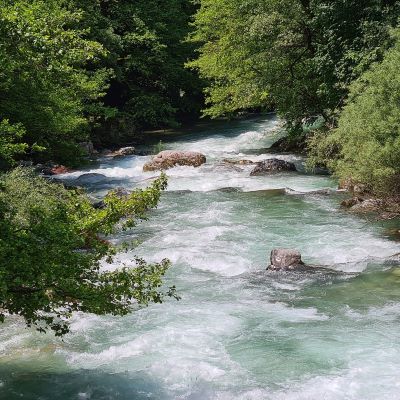
Bigorski would still matter for its history alone, yet the setting gives it an extra force that photographs rarely capture well. The monastery rises above the Radika River in a dramatic western Macedonian landscape, where forested slopes, villages, and mountain routes gather around the valley. A feature hosted on the official monastery site describes views of surrounding forests and villages even before a visitor enters the grounds. The National Park Mavrovo website, while describing nearby trails, also points to lookout points where the Radika canyon and the monastery come into view together. That visual relationship between monastery and valley shapes the whole visit. Bigorski feels anchored in the terrain rather than placed on top of it.
The stone itself matters here too. North Macedonia Timeless says the monastery takes its name from the limestone used in its construction. That detail may seem small at first, yet it changes how you read the complex. The pale stone walls do more than hold the buildings up. They tie the monastery directly to the geology of the region. Bigorski looks as though it grew from the cliff and settled into the slope over time. That close bond between material and setting helps explain why the place feels so coherent. Even before you step into the church, the architecture already speaks the language of the valley.
The Iconostasis That Draws the Eye
Inside the church, the iconostasis forms the artistic center of Bigorski. The monastery’s official “Holy Relics” page describes it as the adornment for which Bigorski is best known and calls it a masterpiece of Miyak woodcarvers. It names Petre and Marko Filipovski Garkata, along with Makarios Frčkovski, as key figures in the carving work, and says they completed it from 1830 to 1835. North Macedonia Timeless gives a closely matching account and adds that the structure is arranged in six horizontal belts. These details matter because they help visitors look beyond general admiration and understand what makes the work exceptional. This is not simply a beautiful screen. It is a major statement of nineteenth-century sacred craftsmanship in the wider Balkans.
The artistry becomes even clearer when you look at the details the monastery itself highlights. The official page explains that the iconostasis combines biblical scenes in carving and paint, and that human figures, animals, and floral motifs all appear in a carefully planned harmony. It also notes a rare feature for this type of church interior, namely three rows of icons rather than the more common two. The Macedonian-language page repeats that point and describes the royal doors and side entrances in rich carved form. For visitors, these details create a more rewarding way of seeing the church. Instead of taking in the iconostasis as a single decorative mass, you begin to notice narrative scenes, symbolic order, and the patience of the carvers who worked through a dense and highly disciplined visual program.
The Miracle Working Icon and the Relics
After the iconostasis, the next spiritual center of Bigorski is the icon of Saint John the Baptist. The monastery’s official history and holy relics pages link the icon directly to the founding story and present it as wonderworking. North Macedonia Timeless adds that the image later received a silver covering and that local tradition connects it with healing and blessing. These descriptions come from the monastery’s own religious tradition, so visitors should read them as expressions of living belief within the community. Even with that in mind, the icon remains central to the experience because it gathers devotion, story, and memory in one object. It is the image around which Bigorski explains itself.
The relics deepen that sense of sacred presence. The monastery’s official page says a decorated reliquary from 1833 holds relics of Saint John the Baptist and a range of other saints, along with a particle of the Holy Cross. It also notes further relics kept in the altar, including those of Saint Clement of Ohrid and several other revered figures. For a visitor with limited background knowledge, this helps explain why the church feels dense with meaning. Bigorski does not center only on architecture. It also centers on veneration, remembrance, and physical objects of devotion that the brotherhood regards as part of the monastery’s living treasure.
A Living Monastery with a Living Sound
Bigorski also speaks through sound. The official monastery history says that after the revival of monastic life in 1995, the brotherhood restored the full daily order of worship. That means the monastery’s life unfolds through service rather than through display alone. Another official page records the participation of the Bigorski choir in the First International Festival of Byzantine Music in Athens in 2021, where the choir represented the monastery and received warm praise for its performance. When you place those two facts together, you get a fuller sense of the atmosphere visitors may encounter. Bigorski preserves church art, yet it also preserves chant, liturgical order, and the daily rhythm of worship.
This living musical tradition matters because it changes the emotional register of a visit. Carving and stone work through the eye, while chant works through time and breath. In Bigorski, the architecture gives shape to the faith, and the services give it movement. A traveler who arrives during a service does not simply observe a monument. They step into an active sacred environment shaped by voice, incense, and procession. That difference helps explain why Bigorski leaves such a strong impression on people who care about history and on people who care about atmosphere. The monastery still uses what it preserves.
How to Plan a Visit That Feels Complete
Bigorski fits naturally into a wider route through the Radika Valley. Since it sits on the road between Gostivar and Debar, travelers often reach it as part of a Mavrovo, Radika, or Debar day. North Macedonia Timeless places it near Rostuše and along the Radika, while the National Park Mavrovo site points to nearby trails and lookouts that open broader views of the canyon landscape. That makes Bigorski a strong anchor stop rather than a short roadside pause. You can pair it with the river valley, the surrounding villages, or a longer mountain drive and still feel that the monastery remains the cultural heart of the route.
Once you arrive, slow down enough to let the place unfold in order. Start outside with the setting and the stone, then move into the church for the iconostasis and the icon of Saint John, and only after that step back to consider the wider monastic complex and the valley below. That sequence mirrors the way the monastery tells its own story, from landscape, to sanctuary, to devotion, to community. Quiet clothing choices and respectful conduct fit the spirit of an active monastery and help the visit feel more grounded. The reward comes from attention rather than speed.
Why Bigorski Stays in Memory
Bigorski stays in memory because every part of it points toward continuity. The foundation story reaches back to 1020. The cycles of destruction and renewal reveal endurance. The iconostasis shows the peak of local woodcarving skill. The icon and relics gather the monastery’s devotional life into visible form. The daily services and choir keep that life active in the present. Very few places hold all of those elements together with such clarity. Bigorski manages to feel historic, artistic, and fully alive at the same time.
In the end, Bigorski offers more than a visit to a famous monastery. It gives travelers a compact lesson in how landscape, faith, art, and memory can shape one place across a thousand years. You see the valley, then the stone, then the carvings, then the icon, and each step adds another layer to the story. That is why Bigorski deserves its place on any cultural route through western North Macedonia. It helps you understand the region through a single, powerful stop that still lives by the values that built it.

Tours that include this place
Bigorski Debar Retreat

Explore Vevčani’s mountain springs, marvel at Bigorski Monastery’s carved iconostasis, then unwind in Debar’s mineral baths. A restorative 13-hour mix of faith, nature, and wellness.
Vevčani Bigorski Tour

Capture Vevčani cascades, sip mountain tea, then marvel at St. Jovan Bigorski’s carved iconostasis. A serene 9h blend of water, faith, and forested roads.
Radika Mavrovo Loop
Soak in Debar’s thermal pools, trace the Radika canyon to chanting Bigorski, lunch by Mavrovo Lake, and return via quiet Kičevo valleys. A scenic 13-hour loop of waters, canyons, and villages.
Mavrovo Villages Trail

From Ohrid to Bigorski chants, then Mavrovo meadows, Galichnik stone roofs, and Lazaropole pines. Picnic views and highland stories fill this 13h escape.