
Korça: Albania’s City of Serenades and Sweet Beer
In southeastern Albania, cradled by the Morava Mountain and spread across a high plateau at 850 meters, lies the city of Korça. The air here feels different. It carries the crispness of elevation and the scent of roasting coffee and malted barley from the local brewery. Korça has long held a special place in the Albanian imagination. People call it the city of culture, the birthplace of Albanian education, and the home of the famous Korça beer. Walk through its streets, and you sense this pride immediately. The wide boulevards, the elegant European-style villas, and the lively bazaar all speak of a city that has looked outward while holding fast to its Albanian soul.
The story of Korça begins in the late 15th century. According to local tradition, the Ottoman general Iljaz Hoxha founded the city, building a mosque and a market that attracted traders and settlers from the surrounding villages. The location offered advantages. The plateau provided fertile land for farming, and the mountains offered protection and pasture. Over the centuries, Korça grew into a significant trading center, connecting the Adriatic coast with the interior of the Balkans. Merchants brought goods and ideas from Venice, Vienna, and Thessaloniki. They returned not only with fabrics and spices but with books and a thirst for modern education. This openness to the world would define Korça’s character for centuries to come.
The Cradle of Albanian Education
Korça earned its reputation as the birthplace of Albanian education through a series of pivotal moments in the 19th century. At that time, the Ottomans controlled Albania, and the Greek Orthodox church dominated religious and educational life. Albanian language instruction barely existed. A group of patriots in Korça decided to change this. In 1887, after years of secret preparations and despite opposition from both Ottoman authorities and the Greek patriarchate, they opened the first secular Albanian-language school in the Ottoman Empire. They called it the Mësonjëtorja, or the Schoolhouse.
This small building on what is now called Shën Gjergji Street became the symbol of Albanian national awakening. Young and old came to learn the Albanian alphabet, to read books in their own language, and to study geography and history from an Albanian perspective. The school operated secretly at times, closing and reopening as political conditions shifted. But its example inspired similar schools across the country. Today, the building houses an education museum where you can see original textbooks, photographs, and classroom furniture from that heroic period. Standing in those rooms, you feel the courage of those first teachers and students who risked so much for the right to learn in their mother tongue.
The French Lycée and Cultural Flowering
The 1920s brought another transformative moment to Korça. After Albania declared independence in 1912 and stabilized under King Zog, the government sought to modernize education. They invited the French to open a high school in Korça, part of a broader effort to bring European educational standards to Albania. The French Lycée opened its doors in 1917 during the French military occupation of the region and continued after the war as an Albanian-French institution. It quickly became the most prestigious school in the country.
The Lycée attracted brilliant minds from across Albania and the Albanian lands beyond the borders. Students studied philosophy, literature, and science in French, reading Descartes and Voltaire alongside Albanian classics. The school produced a generation of writers, artists, and politicians who shaped Albanian culture for decades. Among them were the poet Lasgush Poradeci and the painter Vangjush Mijo, whose impressionist works captured the light and landscape of Korça. The Lycée building still stands today, a reminder of a time when this provincial city sat at the crossroads of European intellectual currents.
The Cathedral of Resurrection
Religion in Korça tells a story of destruction and renewal. The city has long been a center of Orthodox Christianity in Albania, with a substantial Orthodox population living alongside Muslims and Catholics. The original cathedral, dedicated to Saint George, dominated the city center for centuries. Then came the cultural revolution of 1967, when the communist dictator Enver Hoxha declared Albania the world’s first atheist state and ordered all places of worship closed or destroyed. The cathedral of Saint George did not survive. The regime leveled it and built a sports pavilion on the site.
After communism fell in 1990, the Orthodox community faced a decision. They could rebuild the old cathedral on its original site, which would require removing the sports complex. Instead, they chose a different path. They built a new cathedral nearby, on a larger scale, as a symbol of the resurrection of faith after decades of persecution. The Cathedral of the Resurrection, completed in 2002, stands as one of the largest Orthodox churches in the Balkans. Its white stone walls and Byzantine-inspired domes dominate the city skyline. Inside, frescoes cover every surface, painted by modern masters continuing a tradition that goes back a thousand years. The iconostasis, carved in wood and covered with gold leaf, draws the eye toward the altar. Light streams through stained glass windows, creating patterns of color on the marble floor.
The National Museum of Medieval Art
Just a short walk from the cathedral, the National Museum of Medieval Art holds one of the richest collections of Byzantine and post-Byzantine icons in the world. The museum opened in 1980, during the communist era, when the government recognized the artistic value of religious icons even as it suppressed religious practice. Curators gathered icons from churches and monasteries across southern Albania, saving them from destruction and neglect. The collection now includes more than seven thousand objects, with about two hundred on permanent display.
Walking through the museum galleries, you trace the development of Albanian icon painting from the 13th to the 19th centuries. The earliest icons show the formal, otherworldly style of Byzantine art, with elongated figures and gold backgrounds symbolizing divine light. Later works show the influence of Italian Renaissance painting, with more naturalistic figures and landscapes. The museum also displays beautiful examples of liturgical objects, including chalices, crosses, and embroidered vestments. The icon of the Virgin Mary with Christ, attributed to the 14th-century master Onufri, stops visitors in their tracks with its quiet intensity and delicate coloring.
The Old Bazaar and the Taste of Boza
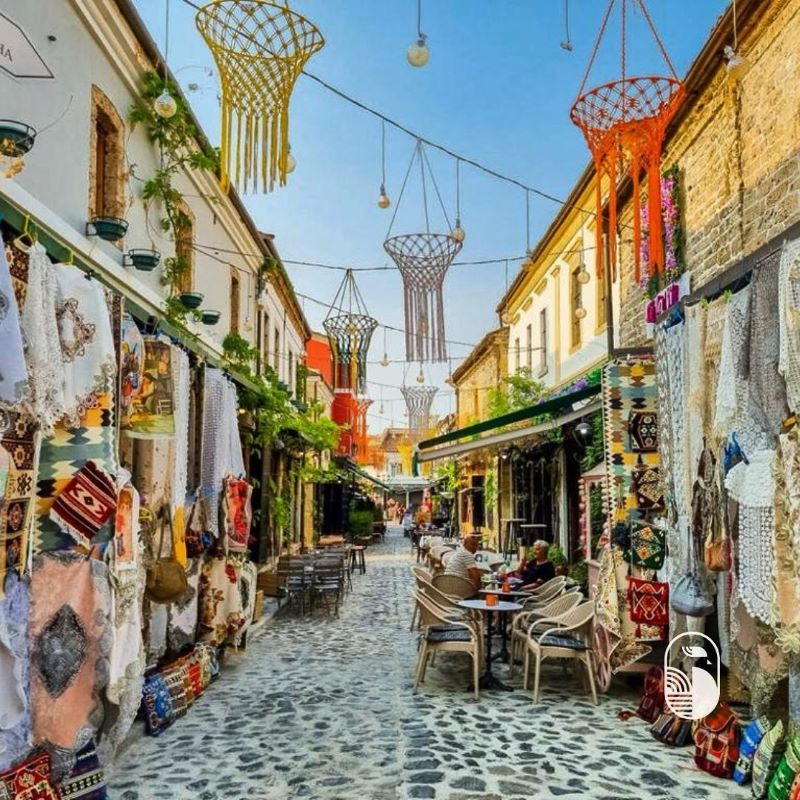
Every Albanian city has its old bazaar, but Korça’s stands apart for its authenticity and charm. The Pazari i Vjetër, rebuilt after a fire in the 19th century, consists of cobbled lanes lined with two-story stone and brick buildings. The ground floors originally housed workshops and shops, while the upper floors provided living quarters for merchants. After decades of neglect during communism, the bazaar has undergone careful restoration. Today, it hums with activity again. Artisans sell handmade copper pots and woven rugs. Cafes spill onto the cobblestones. Restaurants serve traditional Korça dishes.
You cannot visit the bazaar without stopping at one of the historic cafes for a glass of boza. This thick, sweet drink, made from fermented corn or wheat, has a distinctive tangy flavor and a creamy consistency. Albanians drink it year-round, often sprinkled with cinnamon and accompanied by a sesame-covered ring-shaped pastry. The boza of Korça enjoys a special reputation across Albania. Locals will tell you it comes from the water, filtered through the limestone of Morava Mountain, or from a recipe passed down through generations. Whatever the secret, sipping boza in the bazaar as the evening light softens on the old stone walls ranks among the essential Korça experiences.
Brewery Tour and Tavë Kosi
No introduction to Korça would be complete without mentioning its most famous export. Birra Korça, the oldest brewery in Albania, began production in 1928. Italian brothers from the Puglia region, Umberto and Aldo Venesia, founded the brewery using water from the pure mountain springs of Morava and malt imported from Europe. The communist regime nationalized the brewery after World War II but continued production, making Korça beer a national brand. After privatization in the 1990s, the brewery modernized its equipment while maintaining traditional recipes.
Visitors can tour the brewery to see the copper kettles, the fermentation tanks, and the bottling line. The tour ends in the tasting room, where you sample the classic Pilsner alongside newer varieties like dark beer and unfiltered beer. The beer pairs perfectly with the signature dish of Korça cuisine. Tavë kosi consists of baked lamb and rice covered in a thick yogurt and egg custard, baked until golden and bubbling. Albanians everywhere claim this dish as their own, but Korça people insist their version, made with local yogurt and lamb from the surrounding pastures, surpasses all others. You find tavë kosi on every restaurant menu, a comforting taste of home for Albanians and a delicious introduction for visitors.
Winter Carnivals and Serenades
The cultural calendar of Korça features two events that draw visitors from across Albania and beyond. The first, the Korça Carnival, takes place in the weeks before Orthodox Lent. This tradition dates back to the Ottoman period when masked revelers would take to the streets to mock authority and celebrate the coming spring. The communists banned the carnival, but it returned with a vengeance after 1990. Today, the carnival features elaborate floats, costumed groups, and thousands of participants. The atmosphere verges on chaos, a joyful release after the quiet of winter.
The other tradition happens on summer evenings throughout the city. Serenata, the Korça serenade, involves groups of friends walking through the neighborhoods, stopping outside houses to sing love songs accompanied by guitars and mandolins. The tradition reflects the Italian influence on Korça culture, an echo of the time when this city looked across the Adriatic for inspiration. The singers perform with heartfelt emotion, and residents open their windows to listen or come down to join the group. Visitors lucky enough to encounter a serenata performance carry the memory forever.
Practical Korça
Korça rewards visitors who give it time. The city sits conveniently between two other Albanian highlights. To the west, Pogradec offers lakefront relaxation on the shores of Lake Ohrid, one of Europe’s oldest and deepest lakes. To the east, the mountain roads lead to the villages of Voskopoja and Vithkuq, where abandoned churches hold some of the finest frescoes in the Balkans. These painted monasteries, dating from the 17th and 18th centuries, once served thriving Christian communities. Today, they stand in pastoral isolation, their walls covered with scenes of saints and angels.
Within the city, comfortable hotels cater to visitors, and restaurants serve hearty mountain cooking. Buses connect Korça regularly with Tirana and Gjirokastër, making it an easy stop on a longer Albanian itinerary. The climate features crisp, snowy winters and pleasant summers with cool evenings. Spring and autumn offer ideal conditions for exploring. As you leave Korça, driving down from the plateau toward the plains below, you carry with you the taste of sweet beer, the sound of serenades, and the image of that white cathedral rising against the Morava slopes, a city that has shaped Albania’s soul and welcomes the world to share it.

Tours that include this place
Korça Ohrid Heritage

Korça cafés, Moskopole monasteries, lunch in Pogradec, then St. Naum and Bay of Bones before golden-hour Ohrid. A rich 14-hour cross-border cultural arc.
Korça Moskopole Monasteries

Korça stroll and cider, Moskopole’s 18th-century frescoes, and a Galichica picnic viewpoint. A serene 12-hour day of monasteries, scenery, and quiet stories.
Korça Lakes Circuit

From Ohrid to Bay of Bones and St. Naum, then Albanian Pogradec and Korça for lunch and brewery buzz; return via Galichica vistas. Lake calm meets city color in 11h.
Bitola Korça Loop

Bitola heritage, Korça boulevards, Moskopole murals, Pogradec lunch, St. Naum springs, and Galichica ridge views. Thirteen hours, two lakes, many eras.