
Maloviste: Aromanian Heritage, St. Petka Church, and the Pelister Village That Time Slowed Down
Malovište does not win you over with noise or spectacle. It does it with setting, texture, and memory. The road climbs away from Bitola and enters Pelister, and then the village appears in a quiet forest bowl where stone houses, narrow lanes, and mountain silence still shape the day. For travelers who want a village with substance, Malovište offers something rare. It gives you architecture, church art, Aromanian heritage, and mountain access in one compact place, yet nothing feels staged. The village still carries the rhythm of a lived landscape rather than a polished attraction.
Where Malovište sits and why the setting matters
Malovište lies on Baba Mountain within Pelister National Park, and public travel sources place it about 20 to 24 kilometers from Bitola. Heritage documentation identifies it as the only inhabited settlement inside the western part of Pelister National Park, which already sets it apart from other mountain villages in the region. The village stands at the crossing of small streams and below forested slopes, so the landscape shapes every part of the visit. You do not arrive in a broad valley or by a lakeside edge. You arrive in a sheltered mountain basin where houses, water, and steep ground sit close together.
That geography helps explain the mood of Malovište. The village feels inward and protected, yet it also opens toward larger Pelister routes. Cobblestone streets, stone walls, and the rise toward the church create a sense of vertical movement from the first walk. This is one reason Malovište stays memorable. The place has form. It gathers the eye upward toward the slopes and outward toward the traces of an older settlement that once held far more people than it does today.
Aromanian roots give the village its identity
Malovište matters in cultural terms because it is an Aromanian, or Vlach, village with deep historical continuity. The heritage survey for the village states that historical sources mention Malovište in the sixteenth century and identifies its inhabitants as Vlahos or Aromans. The same document says their tradition appears especially clearly in the built environment, from tower-like stone houses to homes shaped by European historicist influence. In other words, the architecture is not just old. It tells the story of a specific community with its own language, customs, and social world.
The village also once held much greater economic weight than its current quiet size suggests. A Pelister source, quoting Vasil K’nchov’s 1900 statistics, describes Malovište as a large village with 2,300 Vlach inhabitants. That number matters because it shows scale. Today visitors see a small mountain settlement with a modest population, but at the turn of the twentieth century Malovište stood as a sizable Aromanian center. Its stronger past helps explain the unusually ambitious church, the quality of the village fabric, and the sense that this place once had broader regional connections through trade and movement.
That older prosperity still shows in the houses. The heritage survey describes interiors designed around domestic economy, residence, and hospitality, with built-in cupboards, wooden ceilings, and vivid woven rugs. Those details add useful context for anyone who wants to understand the village beyond a scenic walk. Malovište was not simply a remote pastoral outpost. It was a community that invested in comfort, craftsmanship, guest culture, and display. Even where houses now stand empty or damaged, the original design language still points to confidence and social standing.
St. Petka gives Malovište its strongest landmark
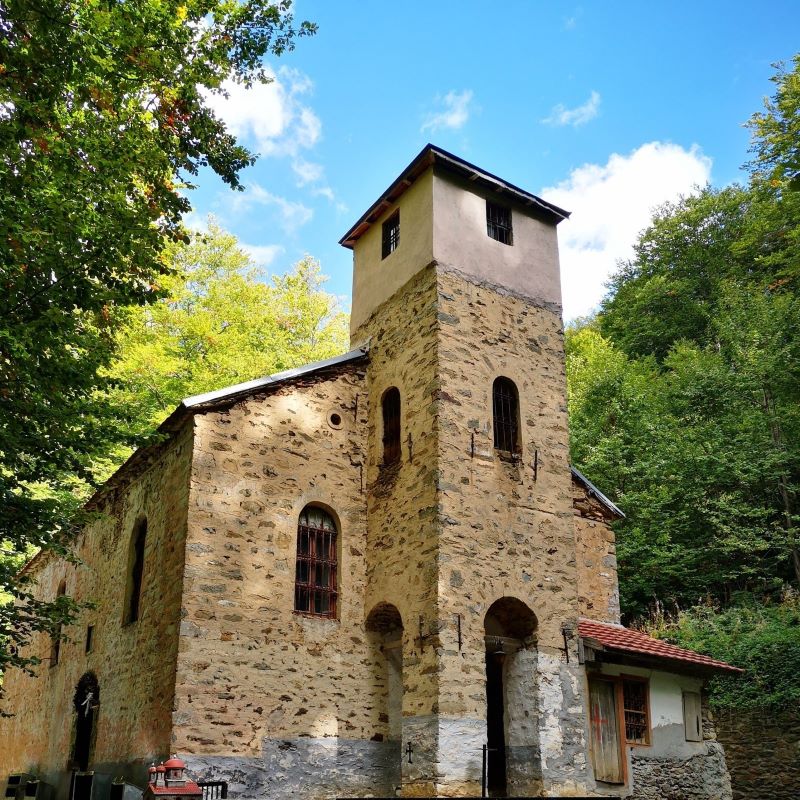
The clearest symbol of that confidence is the Church of St. Petka. Heritage and tourism sources agree that the church was built in 1856 on the foundations of an older sanctuary, probably from the sixteenth or seventeenth century. The church rises in the central part of the village and ranks among the larger architectural structures in Pelister National Park. That scale surprises visitors. In a small mountain village, you expect a compact chapel. In Malovište, you find a church that speaks of a community with money, ambition, and devotion.
The art inside St. Petka deepens that impression. Bitola Info highlights the preserved fresco painting and the richly carved wooden iconostasis, while the heritage survey calls the iconostasis a remarkable artistic creation. A separate reference for the church notes that the carved screen dates to 1892. Bitola Info also points to an icon gallery in the upper rooms, with examples dating from the sixteenth century and tied in part to the earlier church on the same site. This matters for visitors because St. Petka is not only the village’s central church. It is also a compact archive of faith, patronage, and artistic continuity across centuries.
There is also a practical side to visiting the church. Bitola Info states that the church remains locked and that guests need to contact the local church committee in the village for access. A travel account from Journey Macedonia describes a local key-holder opening the church after a short search in the village. That small detail actually fits Malovište very well. The visit still depends on local rhythms and local help. That gives the experience a human feel and reminds you that village churches here still belong to living communities, not just to tourism.
The village walk matters as much as the sights
After St. Petka, the village itself becomes the main experience. Malovište does not need a long list of monuments because the walk between places carries enough interest on its own. Pelister guides and travel sources describe the settlement through authentic stone architecture, cobbled streets, and historic character. The heritage survey adds narrow lanes, visually separated quarters, and a strong relationship between settlement form and the surrounding landscape. As you move through the village, these features create a layered feel. You notice the gradient, the rough stone, the way houses meet the slope, and the quiet that comes from being inside a protected mountain area.
That walk also teaches something about change in rural North Macedonia. Some homes remain in use. Others stand abandoned, altered, or damaged. The heritage survey describes different levels of condition across the building stock, from fair to very poor, with abandonment listed as a major risk. Yet the village does not read as a ruin. It reads as a place in transition, where heritage, memory, and present-day life still meet. For travelers, that makes Malovište more affecting than a fully restored open-air site. You sense both loss and continuity at the same time.
Malovište also opens the door to Pelister walks
One of Malovište’s strengths is that it works both as a heritage stop and as a mountain base. Pelister sources list marked routes from the village toward St. Ana, St. Spas, and Pelister Peak. The St. Ana monastery lies about half an hour on foot southwest of the village at around 1,400 meters in a dense beech forest, according to Bitola Info and the Pelister trail listing. Another marked route climbs from the upper exit of the village toward St. Spas, while a separate Pelister trail continues onward from Malovište toward Pelister Peak.
This makes the village appealing even if you are not planning a demanding hike. You can keep the day light with a short forest walk to St. Ana, or you can use Malovište as a starting point for a longer mountain outing. Pelister’s better-known high-altitude features include the glacial lakes called the Eyes of Pelister, and broader hiking material for the park links the Malovište side of Pelister with deeper mountain routes. For a traveler, that means Malovište gives you options. You can come for culture and stay for the trail, or come for the trail and leave with a deeper sense of local history.
How to plan a rewarding visit
Malovište works best when you give it time rather than rush through it. A half day is enough for the village walk, St. Petka, and a short forest extension. A longer day lets you combine Malovište with Dihovo, Hotel Molika, or another Pelister stop before descending to Bitola in the evening. The road distance from Bitola is short enough for an easy day trip, yet the mountain setting creates a clear break from the city. That contrast is part of the charm. In less than an hour, you move from cafés and neoclassical facades to stone lanes and church keys passed hand to hand in a mountain village.
Good shoes matter here. The village is known for cobbled streets, and the rise toward the church and upper lanes can feel steep in places. If you want to see the inside of St. Petka, ask locally about access as soon as you arrive rather than leaving it for the end. If you want to extend the day on foot, the marked trail toward St. Ana offers the easiest cultural and nature combination. That sequence tends to work well because the church gives you art and history first, and the forest walk adds a calmer outdoor finish.
Why Malovište deserves a place on your route
Malovište deserves attention because it brings several stories together without forcing any of them. It is a mountain village, but also an Aromanian heritage site. It is a quiet settlement, but also a record of nineteenth-century prosperity. It is a place of worn cobbles and abandoned houses, yet also a place of strong church art and living memory. That mix gives the village its depth. You do not visit Malovište only to see one church or one view. You visit to understand how landscape, community, belief, and migration shaped a distinctive corner of Pelister.
For travelers in the Bitola area, that makes Malovište more than a side trip. It becomes one of the region’s clearest windows into highland life, Aromanian identity, and the layered cultural map of southwestern North Macedonia. The village asks for attention rather than speed. If you give it that, it returns something richer than a standard stop on a mountain drive. It returns atmosphere, context, and the kind of quiet detail that stays in memory long after the trip ends.

Tours that include this place
Prespa Ohrid Panorama

Scenic 12-hour corridor: Bitola monuments, Heraclea mosaics, Rotino, Molika, Malovište, Prespa pelicans, Galichica ridge, St. Naum springs, Bay of Bones, Ohrid sunset. Archaeology, wildlife, water.
Pelister Villages Explorer

City-to-mountain loop: Bitola landmarks and Heraclea, Rotino lake picnic, Molika lunch in Pelister pines, then Malovište’s stone roofs and 13th-century church. Heritage, serenity, and village life.
Pelister Galichica Panorama

Two-park panorama: Bitola highlights, Rotino and Molika, Malovište’s chapel, then Galichica ridge with sweeping views of Lakes Ohrid and Prespa. Culture, mountain lunch, and epic photography.