
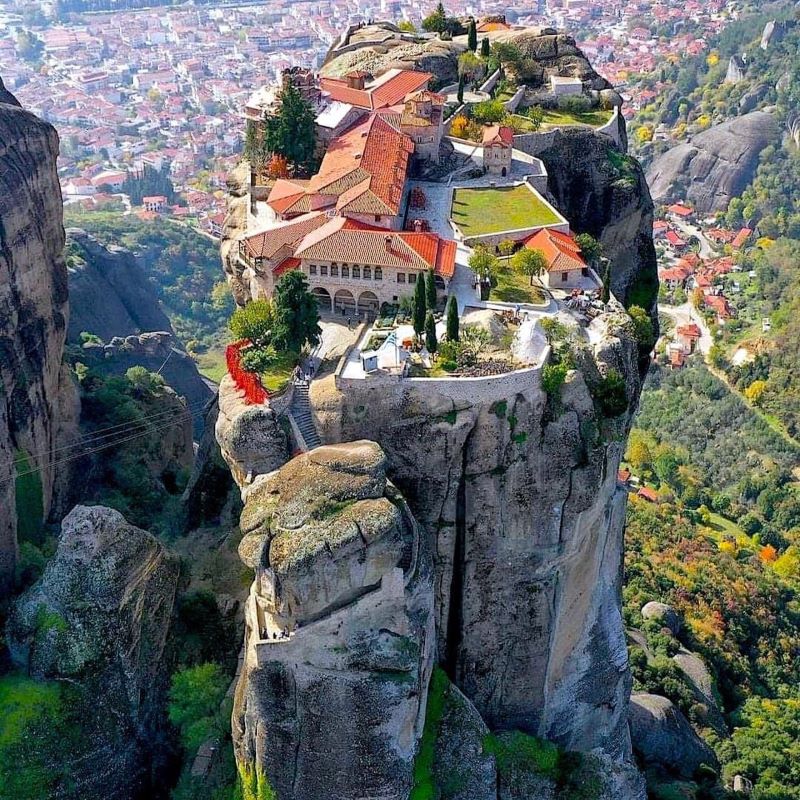
Meteora: Greece’s Monasteries Suspended Between Heaven and Earth
In the plains of Thessaly, where the Pinios River flows toward the Aegean, a strange and wonderful sight stops travelers in their tracks. Giant pillars of rock rise from the earth, their smooth sides reaching toward the sky like the fingers of some buried giant. These immense formations, some towering more than 550 meters above the valley floor, seem impossible. And perched atop them, clinging to the summits like eagles’ nests, sit some of the most important monasteries in the Orthodox Christian world. This is Meteora, a place where geology and faith have combined to create something that exists nowhere else on earth.
The name Meteora means “suspended in air” or “things that are suspended,” and anyone who stands at the base of these rocks understands why. The monasteries appear to float between earth and sky, their walls merging with the stone on which they rest. For centuries, these holy places remained accessible only by rope ladders and baskets, a physical separation from the world that mirrored the spiritual separation the monks sought. Today, steps carved into the rock and paved paths allow visitors to ascend, but the sense of otherworldliness remains. Meteora is not just a destination. It is an experience that changes how you see the relationship between the human and the divine.
The Geology of Wonder
The story of Meteora begins sixty million years ago, long before any human set foot in this valley. At that time, the entire region lay under the waters of a vast river delta. Over millions of years, layer upon layer of sand, gravel, and conglomerate stone accumulated on the riverbed, compressed by the weight of water and time into solid rock. Then the forces of plate tectonics lifted the entire region, exposing the ancient river deposits to air and weather.
Wind and water began their slow work of carving. The softer stone eroded first, washing away to leave behind the harder conglomerate pillars. The process took millions of years, but the result stands today as one of the most dramatic landscapes in Europe. The pillars rise abruptly from the flat plain, their sides nearly vertical, their summits often inaccessible. Early humans found shelter in the caves at their bases, leaving evidence of their presence that archaeologists continue to study. The Theopetra Cave nearby contains a stone wall built twenty-three thousand years ago, one of the oldest man-made structures ever discovered.
The First Hermits
The Christian story of Meteora begins in the 9th century, when hermits seeking solitude from the world discovered the caves of these rocks. They climbed the cliffs using simple ropes and wooden pegs, finding hollows in the stone where they could live in prayer and contemplation. These early ascetics ate little, prayed constantly, and trusted God for their safety on the treacherous heights. They gathered only rarely, meeting in a cave chapel at a place called Doupiani to celebrate the liturgy together.
Over the centuries, more hermits joined them. By the 12th century, a small community had formed, living in caves scattered across the rocks. They built tiny chapels in the larger caves, scratching crosses into the stone and painting simple icons on the walls. The Bandovas hermit caves, tucked into the cliffs and accessible only by difficult paths, preserve this early period of Meteora’s history. You can still visit them today, climbing the trails that wind through the rocks and imagining the lives of those first monks, suspended between heaven and earth.
The Monastic Foundation
The 14th century brought a new chapter to Meteora’s story. The Ottoman Turks were advancing through the Balkans, and the monastic communities of Mount Athos, the great center of Orthodox spirituality, feared for their safety. A monk named Athanasios left Athos with a group of followers, seeking a new place where they could continue their spiritual work in peace. They arrived at Meteora and found the rocks perfect for their purpose. The difficulty of access would protect them from raiders, and the wild beauty of the place lifted their minds toward God.
Athanasios chose the largest and most impressive rock for his monastery. He called it the Great Meteoron, the Great Suspended Place. With the help of other monks and financial support from the rulers of Serbia, he built the first substantial monastery on the summit, completing the Church of the Transfiguration in 1388. Others followed his example. Over the next two centuries, monks built monasteries on rock after rock, until twenty-four of these holy places crowned the pillars of Meteora. They developed systems of rope ladders and windlasses to haul themselves and their supplies up the cliffs, living in total isolation from the world below.
The Great Meteoron
The Great Meteoron remains the largest and most impressive of the monasteries. Its main church, dedicated to the Transfiguration of Christ, follows the traditional Athonite plan with a cross-in-square shape and a central dome rising twenty-four meters above the floor. Frescoes from the 16th century cover the interior walls, their colors still vivid after five hundred years. The monastery also houses a museum with precious icons, manuscripts, and liturgical objects collected over its long history.
Reaching the Great Meteoron requires climbing a series of steps carved into the rock, but these modern conveniences bear little resemblance to the original access. The first monks used only rope ladders that they could pull up behind them, cutting themselves off completely from the world. Later, they developed a system of nets and baskets, hauling themselves and their supplies up the cliffs with windlasses. Visitors today sometimes remark that the nets must be replaced often, and the monks would answer that they replace them only when they break. This story, true or not, captures the spirit of faith that built these monasteries.
Varlaam and the Second Great Monastery
The second largest monastery, Varlaam, sits on a neighboring rock with spectacular views of the Great Meteoron. A hermit named Varlaam first climbed this rock in the 14th century, living there in solitude for many years, but he built no substantial monastery. Two brothers, Theophanes and Nektarios Apsarades, wealthy monks from Ioannina, founded the monastery we see today in 1517. They spent twenty-two years hauling materials up the cliff and building the structures, completing the main church in 1542.
Varlaam contains treasures worth seeking out. The church of All Saints follows the same architectural pattern as the Great Meteoron, with frescoes that rank among the finest in Meteora. A wooden barrel in the monastery holds wine from the monks’ own vineyards, a barrel so large that it has become a landmark in its own right. The monastery also houses a relic of great importance, the finger of Saint John the Chrysostom, one of the most beloved teachers of the Orthodox Church. Visitors who climb to Varlaam at the golden hour, just before sunset, find the stone glowing with warm light and the views across the valley reaching toward infinity.
Holy Trinity and the Bond Film
Of all the monasteries, Holy Trinity sits most dramatically on its rock. The 15th-century foundation perches on a narrow pinnacle, its red roof visible from the valley floor far below. Reaching it requires climbing 140 steep steps cut into the rock, a climb that rewards you with one of the most stunning settings in all of Greece. The isolation of this monastery, its total separation from the world, becomes palpable as you stand on its terrace looking out across the plain.
Hollywood discovered Holy Trinity in 1981, when the James Bond film For Your Eyes Only used it as a location. The film features scenes of Bond climbing the cliff and entering the monastery, bringing images of Meteora to movie screens around the world. Fans of the series still make the pilgrimage to see the site for themselves, standing where Roger Moore stood and gazing out at the same stunning views. The connection to 007 adds a layer of pop culture history to a place already rich with spiritual and artistic significance.
The Monasteries of the Nuns
Two of the active monasteries now house communities of nuns rather than monks. Rousanou, founded in the 16th century and built on a lower rock, passed to nuns in the 1980s. Its small size and graceful proportions make it one of the most photogenic of the monasteries. The nuns maintain the church with its fine frescoes in the Cretan style and welcome visitors who wish to learn about their life of prayer. They also tend gardens on the small patches of level ground, growing vegetables and flowers that add color to the gray stone.
Saint Stephen’s Monastery offers the easiest access of all, connected to the neighboring hill by a small bridge. This convenience has made it popular with visitors, but the monastery deserves attention for its own merits. Nuns have inhabited Saint Stephen’s since 1961, continuing a tradition of women’s monasticism that dates back centuries. The monastery suffered damage during World War II when German occupation forces used it as a military position, but the nuns have restored it beautifully. The church of Saint Stephen, built in the 16th century, contains fine frescoes and an iconostasis of carved wood.
Saint Nicholas Anapausas and Theophanis the Cretan
The smallest of the active monasteries, Saint Nicholas Anapausas, sits on a rock so narrow that the monks had to build upward rather than outward. The monastery rises in layers, with the church occupying the top floor and living quarters and a small cemetery chapel below. This vertical arrangement creates a unique architectural experience, different from any other monastery in Meteora.
Saint Nicholas holds special significance for art lovers. In 1527, a painter named Theophanis Strelitzas, known as Theophanis the Cretan, painted the frescoes in the main church. Theophanis ranks among the greatest masters of the Cretan school, a style that combined traditional Byzantine forms with influences from the Italian Renaissance. His frescoes at Saint Nicholas show the characteristic features of his work, elongated figures, expressive faces, and compositions of great clarity and power. Seeing these paintings in their original setting, on a rock suspended above the plain, connects you directly to the spiritual and artistic vision of the 16th century.
Exploring the Hidden Corners
The six active monasteries draw the crowds, but Meteora offers much more to those willing to explore. Trails wind through the rocks, connecting the monasteries and leading to places the tour buses cannot reach. The path from Kastraki, the village nestled at the base of the cliffs, climbs through forest and rock to the Bandovas hermit caves. These natural hollows in the stone, used by monks from the 9th through the 14th centuries, contain tiny chapels and traces of the lives of the ascetics.
The monks’ prison, another hidden site, sits in a cave accessible only by a difficult scramble. Tradition holds that monks who broke the rules served their penance here, living in total isolation with only bread and water. The location, with its sheer drop to the valley floor and its narrow ledge, makes the severity of the punishment clear. Hiking guides lead groups to these places, sharing the stories and pointing out details you might miss on your own.
Sunset from the Rocks
As the day ends, Meteora transforms. The golden light of late afternoon warms the stone, turning the gray pillars to shades of amber and rose. Shadows lengthen across the valley, and the monasteries seem to glow from within. Photographers gather at known vantage points, setting up tripods to capture the changing light. But even without a camera, the experience rewards you. Standing on a rock outcrop, watching the sun sink behind the Pindus Mountains while the monasteries float above the plain, you understand why the monks chose this place. Here, at sunset, the boundary between earth and sky blurs, and the world feels closer to the divine.
The village of Kastraki offers several excellent viewpoints, and the trails between the monasteries provide countless opportunities for your own personal vantage point. Sunset hikes, led by local guides who know the best spots, allow you to experience this daily miracle without worrying about navigation. The four-to-six-kilometer walks take you through the best scenery and end with the light show that has drawn people to Meteora for a thousand years.
Practical Meteora
Getting to Meteora requires reaching the town of Kalabaka, which sits at the base of the rocks. The town lies about four kilometers from the monasteries, with the village of Kastraki even closer. Trains connect Kalabaka with Athens and Thessaloniki, making public transport possible for those without cars. However, a car provides the flexibility to visit the monasteries in your own time and to reach the various viewpoints scattered around the rocks. The monasteries follow a 17-kilometer circuit, with signs directing you from one to the next.
Each monastery charges a small entry fee, about three euros, and all enforce a dress code. Women need skirts that cover the knees and shoulders covered, while men require long pants. The monasteries provide wraps at the entrances for those who arrive unprepared, but bringing your own saves time and ensures comfort. Opening hours vary by monastery and by day of the week, with each monastery closing on a different day. Checking the schedule before you go prevents wasted trips and allows you to plan your visits efficiently.
The summer months of July and August bring the largest crowds and the hottest weather. Visiting in spring or autumn offers milder temperatures and fewer people. The monasteries open around nine in the morning and close around five, though some close earlier. A half-day visit allows time for two or three monasteries, while a full day lets you see all six and add a sunset hike. Two days give you time to explore the hermit caves and visit the Theopetra Cave with its ancient wall.
As you leave Meteora, descending from the rocks toward the plain, you carry with you images that will not fade. The sight of those monasteries, suspended between heaven and earth, becomes a permanent part of your mental landscape. You have visited one of the great holy places of the world, a place where faith shaped stone into something transcendent. And you understand why, for a thousand years, people have come here seeking God.

Tours that include this place
Bitola Meteora Return

Day trip from Bitola to Meteora: frescoed cliff monasteries, hermit caves, soaring viewpoints, and café pauses en route. A 12h spiritual and scenic Greek detour.
Saranda Meteora Odyssey

Road-trip via Florina, Metsovo, Ioannina and Parga to Sarandë. See Butrint, Blue Eye, Ksamil, then marvel beneath Meteora’s cliff monasteries. A curated 3-day odyssey.