
Ohrid, North Macedonia: A City of Light on One of Europe’s Oldest Lakes
Ohrid feels rich from the first walk. The city rises above the lake in layers of stone, roofs, churches, and narrow lanes, while the water opens wide toward Albania. That meeting of old town and open lake gives Ohrid a rare balance. It feels intimate and expansive at the same time. The appeal runs deeper than views alone. UNESCO lists the Ohrid region for both cultural and natural value, which places it among a small group of mixed heritage sites in Europe. The cultural story reaches back to the work of Saint Clement and Saint Naum, whose legacy shaped Ohrid’s place in early Slavic literacy and Christian learning.
That heritage matters because Ohrid never feels like a museum town cut away from daily life. People still walk the waterfront at dusk, sit for long coffees in the old center, and step into active churches where frescoes still hold spiritual meaning. The city carries history in a way that feels lived in. You sense it in the stone paths, in the church bells, in the boats crossing the water, and in the rhythm of the evenings when the shore fills with conversation. For travelers with limited knowledge of the region, Ohrid offers an easy entry into the wider story of North Macedonia and the Balkans. It brings together faith, landscape, memory, and daily pleasure in one compact destination.
Why Ohrid’s Setting Shapes the Whole Experience
Lake Ohrid gives the city its character from the outset. This lake sits between North Macedonia and Albania and belongs to a much older geological story than the average European lake. UNESCO describes it as a deep and ancient lake of tectonic origin that has existed continuously for roughly two to three million years. Regional basin data describes it as a tectonic lake with a maximum depth of 289 meters, and environmental studies place its surface at about 693.5 meters above sea level. Those figures help explain why Ohrid feels different from a standard lakeside town. The lake is high, deep, and old, and the landscape around it carries that sense of age and scale.
The setting also shapes the mood of a visit. The water often looks calm and luminous, especially in the early morning and near sunset. Hills rise behind the old town, and the lake stretches toward the Albanian shore with a quiet sense of distance. That wide horizon makes even a simple walk feel scenic. It also helps explain why Ohrid developed both as a spiritual center and as a place of trade, travel, and exchange. The city had access to water, routes through the mountains, and a landscape that inspired settlement over long periods. When you stand above the lake and look down at the rooftops, the city’s long continuity begins to make sense.
A UNESCO City with Deep Roots in Slavic Culture
Ohrid’s historical importance reaches far beyond its size. UNESCO’s listing recognizes both the natural value of the lake and the cultural value of the city and surrounding monuments. The property first entered the World Heritage List for natural values in 1979 and for cultural values in 1980, with the listing later extended in 2019 to include the Albanian part of the lake. That shared status reflects the fact that Ohrid and Lake Ohrid form one connected landscape rather than two separate travel stories. The city and the lake belong together in history, in ecology, and in the way visitors experience them today.
Ohrid also holds a central place in the story of Slavic Christianity and learning. Britannica notes that Saint Clement opened the first Slavic school of higher learning and, together with Saint Naum, translated Scripture into Slavonic. Local and national tourism material continues to describe Ohrid as a center of Slavic literacy and as a city shaped by churches and monastic life. That legacy still gives the old town its distinctive identity. You do not need specialist knowledge to feel it. A walk through Ohrid quickly reveals a city built around worship, learning, and artistic expression, with churches, icons, monasteries, and viewpoints appearing one after another as the streets climb and curve above the lake.
The Sights That Define Ohrid
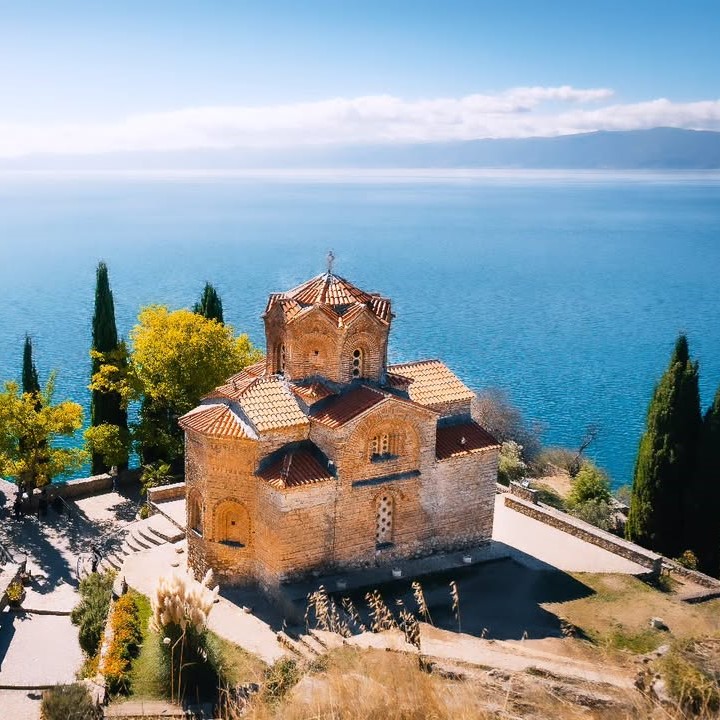
The best-known image of Ohrid usually begins with the Church of St. John at Kaneo. Official tourism material describes it as a 13th-century church set on a cliff above the water, and that location explains its fame at once. The church stands where architecture and landscape work together. You come for the church itself, then linger for the view across the lake. It is one of those rare places where a short visit can still feel complete. The approach through the old town adds to the experience, since the path draws you through lanes, terraces, and open views before the church comes fully into sight.
A different kind of perspective waits higher up at Samoil’s Fortress. The Institution for Protection of Cultural Heritage and Museum Ohrid describes it as one of the largest medieval fortification structures in North Macedonia, occupying the whole hill above the city. From there, Ohrid spreads out below in a way that ties the city together visually. You see the roofs of the old town, the curve of the shoreline, and the lake beyond. That overview helps visitors understand why Ohrid developed where it did and why control of this hill mattered through the centuries. The fortress gives scale to the city’s history and turns that history into something visible.
Outside the urban core, the Bay of Bones adds a much earlier chapter. The Museum on Water identifies it as a reconstruction of a prehistoric settlement near Gradishte on Lake Ohrid. Wooden walkways, stilt houses, and a small museum create a clear and accessible way to imagine how people once lived on this shore. The attraction works well because it connects archaeology with the lake itself. You do not simply read about ancient settlement here. You walk above the water and feel how close daily life was to the lake from the very beginning. It adds a strong educational layer to any Ohrid itinerary, especially for first-time visitors.
Further south, St. Naum Monastery offers another essential stop. Britannica places the monastery roughly 31 kilometers south of Ohrid on a crag above the lake near the North Macedonia and Albania frontier. The setting feels both dramatic and peaceful. The monastery grounds, the lake views, and the nearby springs create a fuller destination rather than a single monument. Visitors often pair the church with a boat ride near the springs, which adds movement and quiet to the visit. For anyone exploring Lake Ohrid beyond the city center, St. Naum gives the journey a spiritual and scenic high point.
The Experiences That Bring Ohrid to Life
Ohrid works best when you do more than move from sight to sight. The lake invites slower experiences that let the place breathe. Official tourism guidance highlights boat rides and visits to St. Naum as classic choices, and that makes sense. Seeing Ohrid from the water changes your sense of the city. Churches and old houses appear in profile, the cliffs near Kaneo gain more drama, and the wide horizon toward Albania comes into view. A boat trip also restores the simple pleasure of travel by water, which fits Ohrid’s mood better than any rushed schedule.
Back in town, Ohrid’s pearl tradition gives the city another layer of identity. Official tourism sources describe Ohrid pearls as one of the city’s signature crafts and a well-known local souvenir. That tradition matters because it shows how Ohrid links beauty with skilled local work. Visiting a pearl workshop turns shopping into a cultural stop. You leave with a clearer sense of what the city values, and you see how craft and story still support local tourism in a direct way. For travelers who enjoy places with a strong handmade tradition, this part of Ohrid feels especially rewarding.
Food and evenings shape the memory of Ohrid just as strongly as monuments do. The waterfront fills with diners at sunset, and the old town keeps a lively yet relaxed tone after the heat of the day drops. Local cuisine often includes lake fish and regional dishes, though Lake Ohrid’s endemic trout also carries real ecological importance in the wider conservation story of the lake. That makes it worth asking questions and choosing reputable places with care. More broadly, Ohrid succeeds as a dining destination because meals usually come with a view, a slower pace, and a sense of occasion. Here, dinner often feels like part of the landscape.
Culture in Ohrid Feels Close and Continuous
Culture in Ohrid lives in both legend and regular practice. Official tourism material still refers to Ohrid as a home of 365 churches, one for each day of the year, which shows how strongly the city is linked with sacred architecture in the public imagination. Whether visitors arrive for religious heritage, lakeside scenery, or a city break, they quickly feel that spiritual density. Churches, monasteries, icons, and old religious buildings appear across the town and around the shoreline, giving Ohrid a layered identity that feels devotional, artistic, and historical at once.
That cultural life also continues through performance. The Ohrid Summer Festival remains one of the city’s signature annual events, with an official festival organization and long-standing recognition in the European festival network. The event brings music and performance into historic spaces and strengthens the link between heritage and contemporary cultural life. This matters for travelers because Ohrid never feels frozen in the past. The city uses its churches, courtyards, and open-air settings as active cultural spaces. History forms the backdrop, and current artistic life steps forward within it.
Practical Tips and the Best Way to Plan Your Time
Ohrid stays accessible for international and regional travelers thanks to Ohrid St. Paul the Apostle Airport, which serves the city directly. Official airport information and national arrival guidance make it clear that Ohrid has its own air gateway, which helps short breaks and shoulder-season city trips work well. Timing also matters. Official tourism guidance notes that July and August bring the liveliest calendar and busiest beaches, while May, June, and September offer gentler weather and fewer crowds. That makes the shoulder season especially appealing for travelers who want clearer views, easier walks, and a calmer pace around the old town.
A classic two-day Ohrid itinerary works very well. On day one, focus on the old town, Kaneo, the fortress, and the lakefront. On day two, head to the Bay of Bones and St. Naum so the wider shoreline becomes part of the story. With a third day, the trip opens beautifully toward the Galichica ridge or onward to Prespa. Travelers who cross Galichica gain views toward both Lake Ohrid and Lake Prespa, while the Prespa region adds a quieter landscape with a distinct character of its own. One final local tip matters in sacred spaces. Official tourism advice asks visitors to dress modestly in churches and monasteries, which helps keep the experience respectful and smooth.
Why Ohrid Leaves Such a Strong Impression
Ohrid stays with people because it joins several kinds of beauty in one place. The lake gives it scale. The old town gives it shape. The churches and monasteries give it depth. The daily life along the shore gives it warmth. Few destinations manage to feel this scenic, this historic, and this easy to enjoy all at once. In Ohrid, each part supports the next. The UNESCO status explains the value. The streets make that value tangible. The lake softens the whole experience and gives it room to breathe.
For that reason, Ohrid suits more than one type of traveler. It works for first-time visitors to North Macedonia, for people planning a cultural weekend, for road trips that continue into Albania or Prespa, and for travelers who want scenery with substance. You can come for churches, for boat rides, for UNESCO heritage, or for simple lakefront evenings. In each case, Ohrid gives more than a checklist. It gives a fuller sense of place. That is why the city and the lake earn their reputation so easily. They offer beauty with context, history with atmosphere, and a trip that feels complete from the first walk to the final view across the water.

Tours that include this place
Ohrid Highlights Trek

Walk Ohrid in 3–4h: pearl workshop, Robevi House, handmade paper, frescoed St. Sophia, ancient theatre, Samuel’s Fortress, Plaoshnik, and Kaneo’s cliff-top chapel.
Bay Bones Heritage

Full-day loop: stroll UNESCO Ohrid, explore Bay of Bones stilt village, boat St. Naum’s springs, and crest Galichica. Culture, nature, and archaeology braided beautifully.
Ohrid Shores Discovery

Tread Bay-of-Bones walkways, boat St. Naum’s springs, lunch in Albanian Pogradec, climb Radožda’s cave-church, toast sunset in Struga. Six lakeside gems in 12 hours.
Ohrid Albania Greece

Three-country circuit: UNESCO Ohrid, Bay of Bones, St. Naum springs, Albanian Pogradec and Korça, then Greek Kastoria and Florina. Crafts, chapels, and lakeside cafés in one epic 14-hour day.