
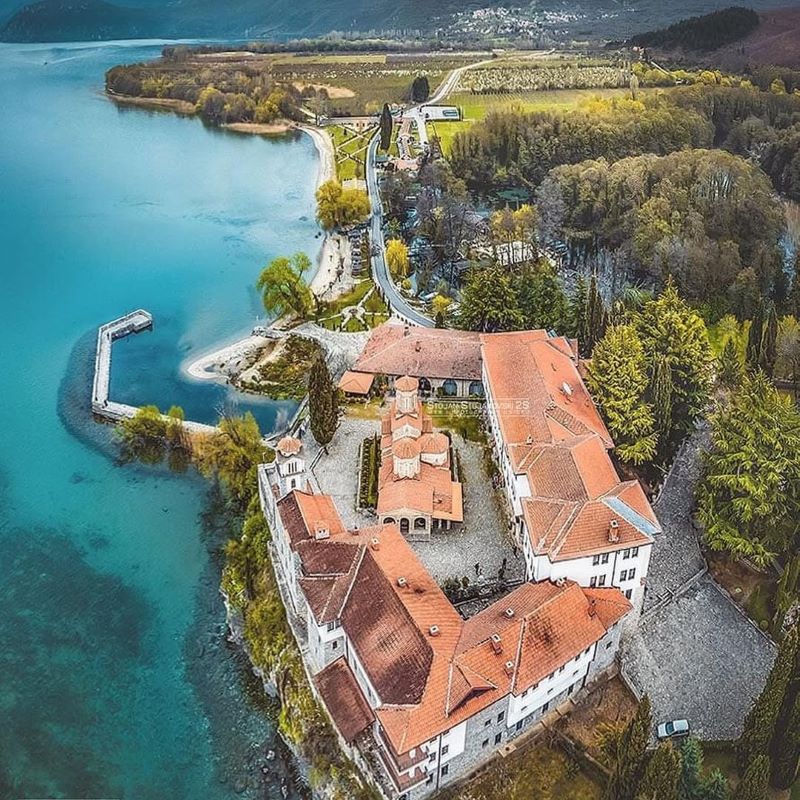
St Naum Monastery and Springs Guide, History, Faith, and Crystal Water on Lake Ohrid
St Naum is one of those places that explains Lake Ohrid in a single stop. You arrive for the monastery, yet the site quickly opens into something larger. It brings together early Slavic Christian history, the memory of Saint Naum, the source area of the Black Drim, and one of the strongest natural settings on the lake. The monastery stands about 29 kilometers south of Ohrid on a high rocky point above the shore, close to the Albanian border and beside the famous springs below Galichica. UNESCO also identifies the St. Naum Springs as part of the World Heritage property of the Ohrid region and part of the Ohrid-Prespa Transboundary Biosphere Reserve.
That setting gives the place its special force. You do not walk into a monument that sits apart from the landscape. The water, the rock, the trees, and the church all work together. Official material from Ohrid describes strong springs around St Naum that emerge from limestone caves at the foot of Galichica, gather first in a small lake, and then run through a short fast stream into Lake Ohrid. That physical setting helps explain why the stop feels both calm and alive. The site carries movement in every direction, from the springs under the mountain to the river that begins here and continues toward Struga.
Why St Naum Matters
St Naum matters because it stands at the meeting point of religion, literacy, and place. The monastery ranks among the early monuments of Slavic church architecture and art in the Ohrid region, and North Macedonia’s official tourism material links Saint Naum directly with the literacy and education tradition that shaped medieval Ohrid. This gives the complex a role far beyond simple sightseeing. A visit here is not just about a scenic church by the lake. It is about a figure who helped shape the spiritual and cultural direction of the region.
That deeper meaning becomes clearer when you connect Saint Naum with Saint Clement and the Ohrid literary tradition. North Macedonia Timeless states that Naum joined Clement in the work of the Ohrid Literary School, and that he led the Ohrid School for seven years before retiring to the monastery dedicated to Saint Archangel Michael. In other words, this site belongs to a story of teaching and writing as much as prayer. When people describe St Naum as a cradle of Slavic learning, they point to that link between the saint, the Ohrid school, and the development of church and literary life in the region.
That legacy still shapes the feel of the visit today. Even travelers who arrive with little background can sense that the place stands for more than architecture. The location itself reinforces that feeling. The monastery rises above the southern point of the lake in a setting that official tourism sources describe as one of rare natural beauty. That combination of spiritual authority and strong landscape explains why the site has drawn pilgrims, visitors, and travelers for centuries.
The Story of the Monastery
The monastery goes back to the life of Saint Naum himself. Official tourism sources place its foundation around 900 to 905, with Saint Naum retiring here late in life and dying in 910. The church at the heart of the complex is dedicated to the Holy Archangels Michael and Gabriel, and Saint Naum was buried here. That fact gives the complex a very personal character. This is not simply a church built in honor of a saint centuries later. It is the place where the founder lived, worked, died, and entered local memory.
The building you see today belongs to several phases of rebuilding and renewal. North Macedonia Timeless states that the original church was destroyed between the 10th and 13th centuries and that the present church rose on the original foundations in the 16th century, with further additions and a major restoration at the end of the 18th century. Visit Ohrid also identifies the present church as a 16th to 17th century structure. This layered construction matters because it explains why St Naum feels both early and later at once. The foundation reaches into the first age of Slavic Christianity in Ohrid, while the present form carries the artistic language of later centuries.
That long life left visible traces inside the church. Official tourism material points to wood carving from the 17th and early 18th centuries, while the tour page on the same platform notes late 18th century baroque icons. These details help visitors read the church with better focus. You are not looking at one frozen moment in time. You are looking at a sacred place that kept growing, receiving art, and gathering meaning across centuries of worship and care.
The Church, the Tomb, and the Heartbeat Legend
For a lot of visitors, the emotional center of St Naum sits inside the church beside the saint’s tomb. Official tourism text explains that Saint Naum was buried here and that worshippers from various religions came for centuries to honor his relics. The same source also records the famous local custom of leaning sideways on the grave to hear what believers describe as the saint’s heartbeat. Whether a visitor approaches that moment with faith, curiosity, or quiet respect, it leaves a mark. It turns the monastery from a beautiful monument into a living place of devotion and legend.
This is also where St Naum becomes easier to understand as a person rather than a name in a guidebook. North Macedonia Timeless presents him as one of the youngest students of Saints Cyril and Methodius, a teacher, a monk, and a figure closely tied to the Ohrid Literary School. The stories of miracles at his grave spread soon after his death, and his cult reached Macedonia, Albania, Bulgaria, and Greece. That wide reverence helps explain why his tomb still forms the spiritual core of the visit. People come for scenery and history, but they stay longer in the church because the tomb carries the site’s deepest meaning.
The Springs Give St Naum Its Second Soul
If the church gives St Naum its spiritual center, the springs give it its second soul. UNESCO describes the St. Naum Springs as part of the Ohrid region’s World Heritage property and notes their ecological value as a refuge for freshwater species. Ohrid’s official history page adds an important geographical detail by explaining that these springs emerge from limestone caves below Galichica and gather first in a small, scenic lake. That combination of clarity, movement, and setting explains why the springs feel so vivid in person. They do not sit beside the monastery as a side note. They complete the place.
The springs also help explain the wider water story of the lake. Ohrid’s official history page notes that a large share of the lake’s spring water comes from underground inflow related to nearby Prespa Lake, while the St Naum springs themselves feed a short river channel into Ohrid. North Macedonia Timeless adds that the Black Drim lies in the immediate vicinity of the monastery and flows onward through Struga. For visitors, that hydrology turns into experience very quickly. You see turquoise water, submerged plants, shifting light, and a current that seems to begin in silence and then gather direction.
This is also the part of the visit where people often slow down. Official tourism material describes the area as strictly protected and highlights the crystal clear spring water that reflects greenery and mountain peaks. Guided tourism pages on North Macedonia Timeless also describe journeys to the springs on a dinghy with an expert guide. That means the classic St Naum experience usually moves in two rhythms. First comes the church, the courtyard, and the saint’s tomb. Then comes the water, where the pace softens and the eye follows color, depth, and light rather than stone and fresco.
What a Visit Feels Like on the Ground
St Naum works so well for travelers because it gives clear visual highlights right away. You approach through a complex that official tourism text describes as home to colorful peafowl, and then you move toward the main gate on top of the rock. Around the monastery stand several smaller churches, including St Petka and St Athanasius, which the Ohrid Cultural Treasury page lists as part of the broader complex. These details add texture to the visit. The site feels like a lived religious landscape rather than a single building with a ticket desk.
From there, the visit keeps unfolding in simple steps. You enter the church, focus on the tomb, take in the carved wood and icon work, and then return outdoors to the lake views and the spring area. The short distance between these parts is one of the monastery’s strengths. You do not need a long hike or a large block of time to feel that the place contains several different worlds. Sacred interior, open courtyard, peafowl, spring water, and lakeside views all sit close together, which makes the stop feel rich without feeling tiring.
How to Plan St Naum Well
St Naum fits easily into a day around southern Lake Ohrid. Lake transport sites in Ohrid describe regular crossings by boat to the monastery complex, and North Macedonia Timeless tour material presents St Naum and Bay of Bones as part of the same southern shoreline route. That makes practical sense. Both sites sit on the same side of the lake, and together they build a strong half day or full day around history, water, and scenery. You can begin with Bay of Bones and then continue south to St Naum, or arrive at St Naum by boat and enjoy the lake itself as part of the experience.
Summer planning calls for a bit more care. UNESCO notes that tourist numbers in the Ohrid region rise strongly in high season and that these pressures affect the St Naum springs in particular. From that, a simple practical rule follows. An early arrival usually gives you a calmer first hour around the church and a softer light over the water before the area grows busier. That is an inference from UNESCO’s note about high season pressure, and it matches the way sites like this usually feel on the ground.
Why St Naum Stays With You
A lot of lakeside monuments give you either scenery or history. St Naum gives you both, and it ties them together in a way that feels natural. The saint’s story leads into the Ohrid school, the church leads into the tomb, the tomb leads into legend, and the legend opens back out toward the springs and the lake. Every part of the visit connects to the next. That continuity is what makes the stop memorable. You do not leave with one isolated image. You leave with a whole sequence of place, belief, water, and memory.
In the end, St Naum deserves its place on any Ohrid itinerary because it explains the region through lived experience. It shows how faith settled into landscape, how learning shaped a monastery, how water shaped settlement, and how a saint’s memory still guides the atmosphere of a place more than a thousand years after its foundation. For travelers with limited time, that is rare value. In one stop, you understand a large part of what makes the Ohrid region special.

Tours that include this place
Bay Bones Heritage

Full-day loop: stroll UNESCO Ohrid, explore Bay of Bones stilt village, boat St. Naum’s springs, and crest Galichica. Culture, nature, and archaeology braided beautifully.
Ohrid Shores Discovery

Tread Bay-of-Bones walkways, boat St. Naum’s springs, lunch in Albanian Pogradec, climb Radožda’s cave-church, toast sunset in Struga. Six lakeside gems in 12 hours.
Ohrid Pogradec Escape

Ohrid icons, Bay of Bones, St. Naum’s crystal springs, lunch in Albanian Pogradec, and Galichica’s balcony road. A relaxed 10h cross-border day of history and horizons.
Korça Lakes Circuit

From Ohrid to Bay of Bones and St. Naum, then Albanian Pogradec and Korça for lunch and brewery buzz; return via Galichica vistas. Lake calm meets city color in 11h.