
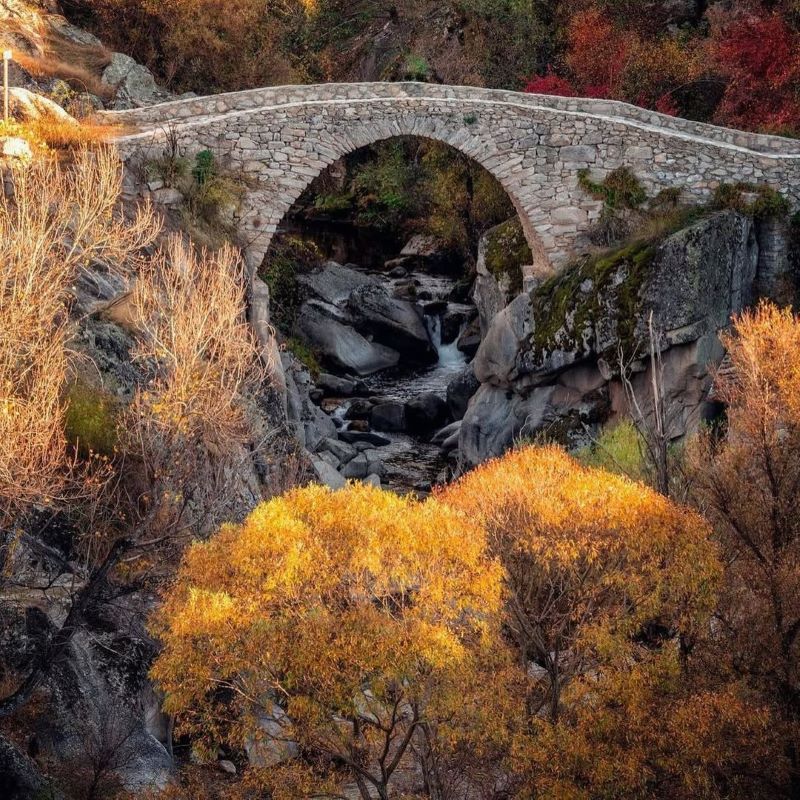
Zovič and the Mariovo Stone Bridge Gorge: North Macedonia’s Canyon of Silence
Deep in the southern reaches of North Macedonia, the Crna River has carved a path through the mountains over millions of years. The result is a dusky canyon of striking beauty, a place where sandstone cliffs rise from emerald water and vultures circle overhead on rising thermals. Here, tucked into this rugged landscape, stands the Zovič Stone Bridge. This elegant Ottoman arch has connected the two sides of the gorge for nearly five centuries. The area around it, known as the Mariovo region, holds a special place in the country’s heart. It is a land of abandonment and wild beauty, of endangered dialects and ancient trade routes. For those who make the journey over the rough gravel roads, Zovič offers a reward unlike any other in the Balkans.
The story of this place begins long before the bridge. The Mariovo region is one of the most isolated in North Macedonia. Surrounded by mountains and carved by the Crna River, it developed its own distinct culture and way of life. The people of Mariovo spoke a unique dialect of Macedonian, called Torlak, which still survives among the elderly and the diaspora. They built their villages with local stone, creating settlements that seemed to grow directly from the rocky ground. The river gorge served as a natural barrier but also as a corridor. Traders and travelers needed to cross the Crna, and so the Ottomans, masters of road building and logistics, constructed the bridge at Zovič in the 16th century to serve the caravans moving through this wild country.
The Stone Bridge That Time Forgot
The Zovič Bridge spans the Crna River at one of the narrowest points of the gorge. It is a simple but masterful structure, built from local stone with a single arch that rises gracefully above the water. The bridge was not just a crossing point. It was a vital link in the Ottoman caravan network that connected the Aegean ports with the interior of the Balkans. Caravans of horses and mules, loaded with goods like salt, wool, and grain, would have crossed this arch. Travelers rested here in the shade, watered their animals in the river, and continued their journeys into the mountains. The bridge brought commerce and connection to this remote region.
Today, no caravans cross the Zovič Bridge. The road that once led to it has faded to a rough track, and the only traffic comes from the occasional hiker, fisherman, or photographer. Standing on the bridge, you can feel this history pressing in from all sides. The stone blocks, worn smooth by centuries of use, hold the memory of countless footsteps. The arch has survived floods, earthquakes, and two world wars. During World War I, the nearby mountains and villages of Mariovo served as a frontline, with soldiers from different empires fighting and dying in these harsh landscapes. The bridge stood through it all, a silent witness to the passage of history.
Life in the Gorge: Turtles, Vultures, and Wild Herbs
The Crna River Gorge around Zovič supports a surprising diversity of life. The river itself is home to the rare Vardar turtle. On sunny days, you can spot these small turtles climbing onto rocks and fallen logs to warm themselves in the morning light. They slide back into the water with a soft splash when they sense movement, adding a touch of wildness to the serene scene. The riverbanks also show the tracks of wild boar and deer that come down from the surrounding plateaus to drink.
Look up, and you might see the shadows of griffon vultures circling overhead. These massive birds nest in the cliffs of the gorge, riding the thermal currents that rise from the canyon. They scan the ground below for carrion, playing their essential role in the ecosystem. The drier slopes above the river support a thick growth of wild sage and other aromatic herbs. When the summer sun beats down on these plants, they release their scent into the air. The whole gorge fills with the clean, sharp fragrance of sage and thyme. This is the smell of Mariovo, a perfume that stays with visitors long after they leave.
The Abandoned Villages of Mariovo
Cross the Zovič Bridge and continue into the heart of Mariovo, and you enter a landscape dotted with stone ruins. The villages of this region, places like Gradešnica and Živovo, tell a story of departure and loss. For centuries, the people of Mariovo lived a hard but self-sufficient life. They herded sheep on the high plateaus, cultivated small terraced fields, and wove thick wool blankets to protect against the harsh mountain winters. Their houses, built from the same stone as the cliffs, clustered together for protection and community.
But the 20th century brought change. The isolation that preserved their culture also made modern life difficult. After World War II, people began to leave. They moved to the industrial cities like Bitola and Prilep or emigrated overseas to Australia, Canada, and the United States. The villages emptied. Roofs collapsed, walls crumbled, and nature slowly reclaimed the streets. Walking through these abandoned settlements today, you see stone cottages with gaping windows and empty doorways. Fruit trees, planted by long-gone hands, still bear fruit in the yards. The silence in these villages is profound, broken only by the wind and the distant bark of a shepherd’s dog.
The Torlak Dialect and Wool Weaving Traditions
With the people went their language. The Torlak dialect, spoken in Mariovo and other parts of the southern Balkans, is not just a variation of Macedonian. It preserves ancient Slavic features and includes words and sounds found nowhere else. Linguists consider it endangered, as younger generations grow up speaking standard Macedonian or the languages of their new countries. The old stories, songs, and jokes of Mariovo, passed down orally for centuries, now exist mostly in memory. If you visit during a festival or encounter an elderly local tending sheep, you might hear this ancient dialect. It sounds like music, a connection to the medieval Slavic world that once covered these mountains.
Another tradition survives against the odds. Women in Mariovo still practice wool blanket weaving. They use the wool from their own sheep, cleaning, spinning, and dyeing it by hand using natural materials. The designs on these blankets are geometric and bold, using colors derived from local plants and minerals. Owning a Mariovo blanket means owning a piece of this disappearing culture. The honey from Mariovo also holds a special reputation. Beekeepers move their hives to follow the wildflower blooms, producing honey with the complex flavor of the mountain herbs. If you meet the lone beekeeper who tends hives near the Zovič Bridge, you can buy bundles of wild sage and taste honey that carries the essence of the gorge.
The Golden Hour over Sandstone Cliffs
Photographers and artists find themselves drawn to Zovič at specific times of day. The sandstone cliffs that line the gorge take on different characters as the light shifts. In the harsh midday sun, they appear pale and bleached. But during the golden hour, the hour just after sunrise and before sunset, the cliffs glow with warm orange and red tones. The light reflects off the stone and onto the water, turning the river into a mirror of fire. This is the moment to capture the bridge with the dramatic cliffs as a backdrop.
The best time to photograph the bridge itself is between eight and nine in the morning. At this hour, the water in the gorge lies calm and still before the afternoon winds begin to blow. The bridge reflects perfectly in the surface of the Crna River, creating a symmetrical image of stone and water. As the morning progresses, a breeze usually picks up, rippling the surface and breaking the reflection. Early risers get the reward. For drone operators, the switchbacks of the road approaching the gorge from the plateaus above offer spectacular compositions. The road winds like a ribbon down the bare slopes, a testament to the engineering required to reach this remote place.
Planning Your Journey to Zovič and Mariovo
Reaching the Zovič Bridge requires determination. The last ten kilometers of the road are unpaved gravel. After rain, the surface can become slippery, so a vehicle with good ground clearance provides peace of mind. The road offers no services. You will find no shops, no cafes, no fuel stations. You must carry all the water and food you need for the day. This isolation protects the area’s wild character. Without it, the magic of Zovič would long ago have been diluted by development.
The best way to experience this region is as a day loop from the nearby city of Bitola. Start early, drive to Zovič, and spend the morning exploring the bridge and the riverbanks. Continue into the Mariovo heartland to visit the abandoned villages of Vitolište and Gradešnica. Then loop back through the mountains toward Kruševo, another historic town with its own story.
For the truly adventurous, overnight camping near the gorge opens up another dimension. The night sky here, far from any city lights, reveals the Milky Way in stunning detail. Star photographers rate this location among the best in North Macedonia. As you sit by the river, listening to the water flow beneath the old Ottoman arch, you understand why this place endures. Zovič and Mariovo are not just destinations. They are journeys into the deep soul of the Balkans.
To visit Zovič and its well-known stone bridge, take a look at Mariovo Off-Road.
